Showing posts with label Saints. Show all posts

1.16.2021

Saint Anthony of the Desert - January 17

 by Fr Yuhanna Azize


Anthony the Great is believed to have lived for 105 years, from 251 to 356, dying on 17 January, the day when we celebrate his feast. He was born in ancient Egypt, while the pagan religion was shrinking but still alive there, although by the time of his death it, too, was about to expire. His parents were Christian, and wealthy. He was a religious and contemplative child. At the age of 18 he was orphaned, and so probably became wealthy. But at church he heard a voice saying: ““If you want to be perfect, go, sell what you have and give to the poor, and you will have treasure in heaven; and come, follow Me.” (Matthew 19:21) He did just that, donating all he had to the poor, and pacing his sole sister with some good women.

Although he had a teacher in the solitary life, he went to live in a graveyard outside the village (which is where all graveyards were at that time). He survived on bread and water, and often stayed inside a tomb, so that he could remain alone. He was plagued with temptations by the Evil One, who would appear to him, sometimes in human form, sometimes in bestial form, or as a monster. According to St Athanasius, whose biography, written only a few years after his death, is our best source for him, St Anthony realised that the form the devil took was related to his own interior state. That is, the devil was tempting him where he was weakest.

It is said that in about 285, when he was almost 35 years old, he was so affected by the crowds of people who came to see him, that he went to live in an old fort or castle on the Nile River. There he remained for twenty years, living as a hermit, until he had obtained mastery of his thoughts, desires, and emotions. There is a very great truth here: a person who can force themselves to live alone can in fact build up a tremendous power inside, because they have to overcome the desire to be with others and to see the rest of the world, endless times each day. However, he did have pupils: people who were attracted by his reputation for holiness and impressed by his austerity took up residence near but not with him. Again, this is true: a person comes to a certain stage of spiritual development and then they must teach others if they are to progress, after all, there are things one can see in others but not, at first in oneself. But once we have seen them outside, we can see them inside.

In 311, he learnt that the Christians were being persecuted in Alexandria, and he decided to go there himself and to encourage them to stand fast. He would have been 60 years of age. This persecution, part of the Diocletian, was so vehement that it is said 660 Christians were killed there in the eight years up to 311. The fact that the persecution in Alexandria went on for that length of time before St Anthony went to their help tells us that the sort of communication he had with others was probably entirely spiritual. He was such a commanding figure that, in Alexandria, he was not himself attacked.

When this was over, he retired to a spot on the Red Sea, called Mount Colzim, where he had a cave, water, and some palm trees. He grew wheat, and if people brought him anything, he gave them one of the baskets he was weaving to keep himself usefully occupied. Here he obtained great fame as the organizer of spiritual life and solitary discipline: even if the solitaries lived near each other in order to render mutual support. At about the age of 85, in 335, he went to Alexandria at the request of St Athanasius to preach against the Arian heresy. However, he returned to his cell, for, he said, a monk out of his cell is like a fish out of water. As he grew older, he needed to be cared for, and two monks helped him. He ordered that his place of burial be kept secret so that there be no cult over him.

While his place of rest has never been found, he has been the centre of devotion for his extraordinary victories in the spiritual life, and the teaching and example he gave to others. He is greatly honoured among Maronite monks for his contribution to monasticism, and hence is honoured by all Maronites.

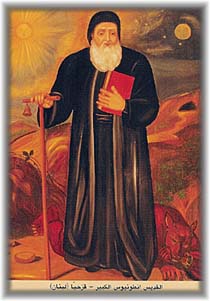
At the monastery of St Anthony, Qozhaya, named after him, they have this extraordinary painting . In one picture, we see the whole of the spiritual life and how to live it. First, we see the saint himself. He is looking down in humility, but he is not stooped – he is upright in Christ, and unembarrassed. He is elderly, and walks with the aid of the “tau” walking stick – the “tau” or capital T was how they depicted the Cross on which Our Lord was crucified.

The picture is read from our left to the right: to our left (his right) is the cave in which he lived and from which the beast has come. This represents the sinful impulses inside us. But he leant on the power of God, represented by the tau waking stick, and so the creature is tamed and lies quietly at his feet. The bell on the staff is used to call the beast to be quiet (it is sometimes said to be a pig, but here it is clearly a monster). This is very profound: our memory of our sins never disappears, but the sinful impulse is tamed, and if it rises up, a little ring on the bell, and it takes its proper place.

Both the sun and the moon are in the sky and shining because he is no longer in earthly time when it can only be day or night. He is beyond life and death, he is in eternity. The final detail to remark on is the book. He may have been illiterate, which means that God’s universe and the laws He writes on our hearts were St Anthony’s book. He has the book but he does not need it: he reads without looking at a word, because he reads with the eyes of faith.

May his prayers always be with us.

8.01.2020

The 350 Martyrs: Part I

The 350 Martyrs: Part 1 (The Holy Martyrs)
On 31 July each year, the Maronite Church remembers the 350 Maronite monks who were martyred in the year 517, slain by other Christians for no other reason than being orthodox Christians.
In The Maronites: The Origins of an Antiochene Church, Abbot Paul Naaman takes their history from a letter from the archimandrites, (that is, abbots and senior abbots), and monks of Syria Secunda to Pope Hormisdas (514-523). Syria Secunda was the inland part of ancient Syria, and Apamaea (Arabic: Afamiyya) on the Orontes River was its capital. (p. 43)
There is a second letter from the monks of Apamaea to their own bishops, also written in 517. This, too, is signed by Archimandrite Alexander of the monastery of Maroun. It states, as the first had done, that the purpose of the monks in travelling had been peaceful. There is also a reply from Pope Hormisdas dated 10 February 518. So, the evidence for the feast of the martyrs is based on three letters, a point which is often missed.
The first letter, the one to Pope Hormisdas reads, in part: “To Hormisdas, the most holy and blessed patriarch of the whole world, the holder of the See of Peter, the leader of the apostles, the earnest petition and humble prayer of the least (important) archimandrites and of other monks of your province Syria Secunda.”
“The grace of Christ, the Redeemer of us all, has instigated us to take refuge with your blessedness as if (taking refuge) from the winter storm in the stillness of a harbour. We are admonished to, and, indeed believe, that, even though disasters encompass us on all sides, we are in no way caught in. For even if we suffer, we endure it with rejoicing, knowing that the sufferings of the present time are not worthy of the future glory, which will be revealed in us.”
“(We have been opposed by) … Severus and Peter, who have never been counted among the number of Christians, who on each single day have attacked and publicly anathematized the holy synod at Chalcedon and our most holy and blessed father Leo. … when we were going to the cell of Mar Simeon for the cause of the Church, they (men instigated by Severus and Peter) were lying in wait for us on the way as it had been announced, defiling us, and when they came upon us by surprise, they killed three hundred and fifty men from among us, and certain ones they wounded; but others, who could take refuge to the venerable altars, they slew there and set the monasteries on fire, inciting throughout the night a multitude of unsettled people and mercenaries. They wasted all the poverty of the Church through destructive trouble makers of this kind. About the details, however, the writings may instruct your blessedness, which were brought over by the venerable brothers, John and Sergius, whom we had sent to Constantinople …”
“We pray, therefore, most blessed one, we go on our knees and ask, that you stand up with fervour and zeal and rightly have pity for the body that is torn to pieces (for you are the head of all); and that you avenge the faith that has been despised, the canons that have been trodden under foot, the fathers who have been blasphemed and such a great synod that has been attacked with anathema.”
Pope Hormisdas’ reply adds little to this. The opening reads: “Hormisdas, to the priests, deacons, and archimandrites of Syria Secunda.”
“I have read your highly esteemed letters, by which the insanity of the enemies of God has been laid open and the obstinate fury of the unbelievers, who with revived spirit hate the Lord and thereby wickedly persecute his members, has painfully been exposed. To the extent that it pertains to the recognition of your perseverance, I praise God that he preserves the faith of his soldiers in the midst of adversities.”
The third letter, from the monks of Apamaea to the bishops, was translated into German and French by Suermann in Histoire des origins de l’Église Maronite (PUSEK 2010). This letter blames Severus for what occurred as they were travelling through an area called “Kaprokeramée”. It does not mention the number slain and captured, but gives more details of how the monks could not defend themselves against the attacks (pp. 95-100).
The clash between Monophysite and other Christians arose after the Council of Chalcedon (451): to be brief, they had different ideas of the nature of Christ. Although only theologians could understand the argument (and even they may not have been clear about it), because these thinkers led their churches, they split Christianity into two bitterly divided factions, a rift which is only being slowly healed today.
In Part 2, I shall deal with an objection to the historicity of this account, and in Part 3, with the spirituality of this feast.  Read More Here
Cornelia B. Horn, writing in the Journal of Maronite Studies, translated both the letter from the monks to Pope Hormisdas and his reply. Her article is still available on the internet: http://www.maronite-institute.org/MARI/JMS/october97/The_Correspondence_Between.htm
Joseph Azize, 2 April 2017 revised 24 July 2020

7.23.2020

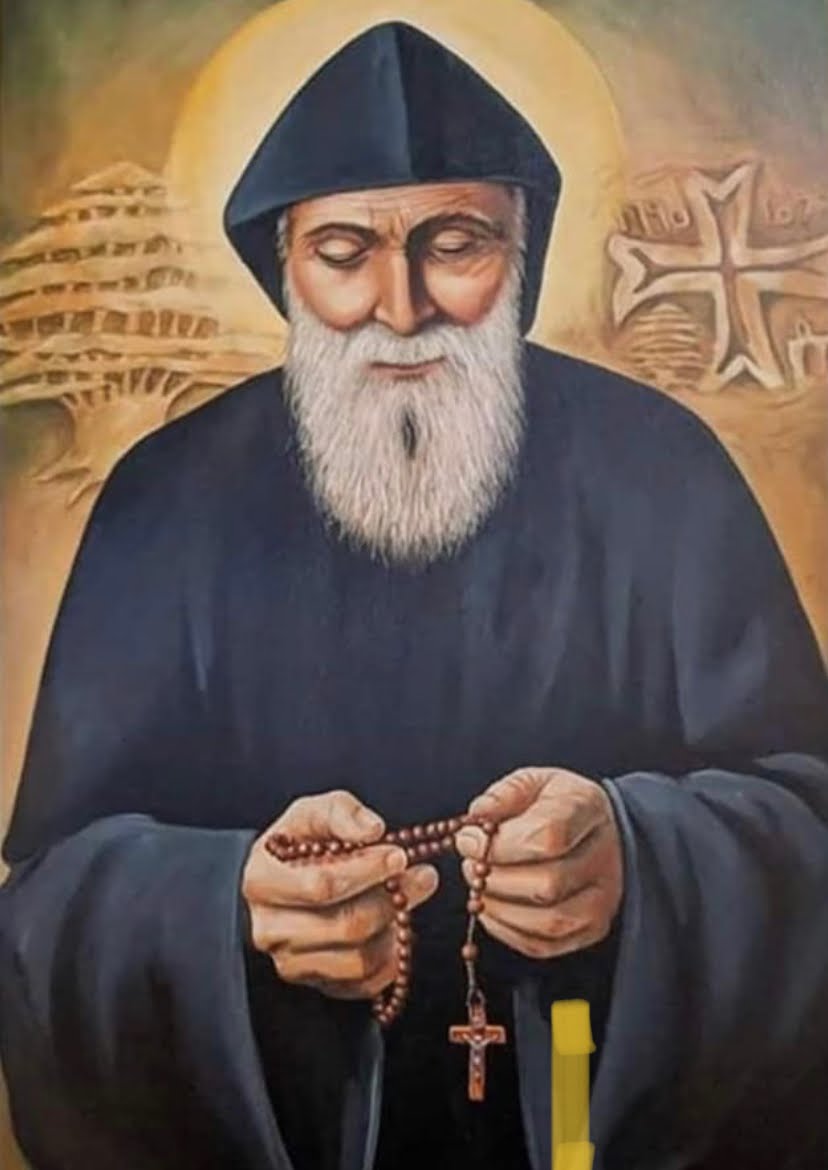
Saint Sharbel


By Emily Lattouf, a postulant with the Maronite Servants of Christ the Light 

As a Maronite, it’s not hard to love Saint Sharbel, especially since my family is from Baakafra, the village where Saint Sharbel was born (May 8th, 1828). I have always loved Saint Sharbel.  I was born on May 6th which was close enough to his birthday that my mother gave me the middle name Sharbela. During my childhood visits to Baakafra, I would participate in the week-long celebrations leading up to Saint Sharbel’s feast day.  The tiny village would be packed with people from all over!

Who is this Saint celebrated and loved by so many? As I got older, I realized that I did not know Saint Sharbel as well as I should. I knew about his life and how great he was because everyone “said so” and I would hear stories of different miracles. I decided to start reading up on Saint Sharbel. My relationship with him began to grow and my prayer life too. 

What I love about Saint Sharbel is that he was a sinner in need of God’s mercy. He like us had to work on himself to become a saint. One of the last prayers he recited before having a fatal stroke during Liturgy in 1898 was “Oh Father of Truth behold Your Son, a sacrifice pleasing to You… many are my sins, but greater is Your mercy.” Saint Sharbel knew who he was in his relationship to God. He knew that He was nothing on his own, and he had confidence not in himself but in God’s mercy. He persevered in his trials. Can you imagine if he had said, “Lord what’s the point of working hard to become a saint, I cannot rise to you, I am a sinner” or “I am just so perfect I was born a saint.” If St. Sharbel lived in despair of his sinfulness or in an illusion of his own goodness, he would have given up the fight for holiness. 
Instead of hiding his sins, he turned to God and prayed “consider the sin and consider the atonement; the atonement is greater and exceeds the sin.” St. Sharbel had such confidence in the blood of Christ. 

Through the merits of Christ, may we run to the Father of Truth, as did Saint Sharbel, with the confidence of beloved sons and daughters.

 “Father of Truth, behold Your Son, a sacrifice pleasing to You. Accept this offering of Him who died for me; behold His blood shed on Golgotha for my salvation. It pleads for me. For His sake, accept my offering. Many are my sins, but greater is Your mercy. When placed on a scale, Your mercy prevails over the weight of the mountains known only to You. Consider the sin and consider the atonement; the atonement is greater and exceeds the sin. Your beloved Son sustained the nails and the lance because of my sins so in His sufferings You are satisfied and I live.”


7.17.2020

Saint Charbel


Born Youssef Makhlouf in Beqa Kafra on 8 May 1828, he was the fifth child in a family of simple farmers. When he was three years old, his father was taken away by the Ottoman Army, never to return. Youssef was sent to the village school, and as a child was given to prayer. At a young age, he knew that God was calling him to become a monk. He prayed to Our Lady to make it come to pass. Two of his mother’s brothers were already monks. However, he did not leave until 1851, when a woman indicated her desire to marry him. Saying nothing, he left home the next morning to enter the monastery of Our Lady of Mayfouq, which was run by the Lebanese Maronite Order (“the LMO”). However, he was pursued there by his uncle, mother and relatives. They begged him to return home, marry, work and look after them. Charbel refused, saying that God wanted him entirely. It is said that in the end his mother gave her consent, telling him to be a good monk, but if he was going to be mediocre, then he should return home.  READ MORE HERE 

2.07.2020

Saint Maron - His Life and Disciples

By the Maronite Monks of Adoration, Petersham MA

Saint Maron
IT IS A TYPICAL NEW ENGLAND, winter day: overcast skies and temperatures hovering above freezing. Inside, our well-heated monastery makes for a cozy home, taking most of the effects of winter off our minds as we live another day of contemplative, monastic life near the Blessed Sacrament.

Given the comforts of modern living, even within amonastery, it is easy to forget that our Maronite monastic roots began, not only with the inconveniences of living in the deserts of ancient Syria during the fourth and fifth centuries, but the added choice of spending much of that time exposed to the elements.

Our father in faith, St Maron, and a number of his early disciples, both men and women, lived as open-air hermits, a unique form of monasticism even in its day. As our Maronite Calendar takes us through their feasts, beginning with that of St Maron on February 9, and going through several of his immediate disciples in the following weeks (curiously enough, during some of the least pleasant days of the year), we can reflect on their lives and the relevance they have for us today.

Nearly all we know about St Maron comes from scarcely a single page written about him by Bishop Theodoret of Cyrrhus (393–466AD). READ MORE 


9.07.2019

The Spirituality of St Isaac the Syrian (Isaac of Nineveh)


"A little endurance in the face of small matters will hold back danger when serious ones come." 
St Isaac the Syrian (Feast Day August 23rd, Maronite Calendar)

St Isaac sought to find and teach the way to God through a Christian life in which worship, the sacraments and prayer, transform and uplift the whole person: body, heart and soul. This saint truly exemplifies the Syrian emphasis on including the body in the process of sanctification, so that matter is not disdained, but is lifted to the divine. 
Although he was a religious solitary, writing for religious hermits, he was full of wisdom and common sense: e.g. the proverb above about the importance of watching the small steps which make up our journey. 
The Maronite Synaxarion notes that the feast of St Isaac the Syrian is celebrated, in our Church, on 23 August, and states: “Saint Isaac was born (about 613) in the region of Qatar, on the Persian Gulf. In his time, the seventh century, Qatar was an important Christian centre, and gave the Church a number of distinguished writers, many of whom were mystics. Isaac adopted the monastic life, but was chosen by Patriarch George I to be bishop of Nineveh (today Mosul), in Mesopotamia, in the year 676. But after five months was (somehow) obliged to resign his See, and removed to Khuzistan, in Jabal Mattuth, and then to the nearby monastery of Rabban Sabour.” It is not known when he died, but it was, perhaps, around 700. In some of the Orthodox Churches, his feast is celebrated on 28 January, with that of St Ephrem. 

Body, Heart and Mind 
“Every prayer over which the body (fagro) does not share the toil, and over which the heart (lebo) does not feel suffering, you should consider to be stillborn (yaHTo).” St Isaac means that if our prayer is purely intellectual, passing through the mind but making no impact on our feeling of ourselves and our hearts, it is without the possibility of progress in the spiritual life. That is why he describes it as being “still-born,” it had potential but that potential will not lead anywhere. St Isaac understood that the mind may see a need for change, and may direct it, but the power to change comes from the body and the heart. 
In another place, St Isaac observes that it is crucial to take a good reverent posture of the body when praying: a person’s posture tells us much about their state and their attitude. St Isaac advises us to stand, to raise one’s arms, or to even lie prostrate on the ground in order to prepare the body for prayer. It is not that God needs us to take humble and beseeching positions: rather, it is we who benefit from them. The point is to take a posture which is a sign of good intention and where we can best hold our attention: this is very difficult indeed when lying down on our backs, or hunched up. 
St Isaac here bases himself on two facts: the Incarnation of the Lord as a human being, and the fact that we are still in our bodies. The Lord did not despise the human body – neither should we. We are not disembodied spirits, and so we should not pretend that “prayer of the heart suffices by itself …” (Sebastian Brock, The Syriac Fathers on Prayer and the Spiritual Life, 276). It is true that what is born of the flesh is flesh and what is born of the spirit is spirit, as the Lord said (John 3:6). St Isaac’s point is that the spirit can infuse the body, lift and transform it.

The Syriac Approach to the Divine 
It is no surprise to anyone acquainted with Syriac thought that St Isaac’s approach to God is typological, that is only the divine world is true and real; this world is an image of the divine. We can move towards God because He appears to us as an image, a “true icon of the world beyond” (yiqoneh Å¡ariro d.3olmo dal.hal) (see Mary Hansbury, Isaac the Syrian’s Spiritual Works, 8), and prayer is the best way of bringing the mind to “fellowship” (neÅ¡tawtaf, from the same root as the word for Eucharistic Communion). 
A premium is placed on work, stillness and meditation. There is no contradiction here, for if one can work with interior stillness, there is pure action, and we can then be busy in the world while maintaining purity of intention. The word used for “meditation” is often renyo, “thinking, paying attention”, a thought which is a quiet gazing upon pure reality, without illusion. Another word for meditation is hergo (to let the mind dwell on God’s plan for salvation, from the creation through to the Second Coming). 
The cleansing of our thought and our seeing begins, says St Isaac, with a sense of wonder, tehro, in Syriac. What is wonder? In the Syriac tradition, it is not just seeing something as if for the first time, and with an emotion of surprise, it is also the emotion of joy or ecstasy which comes with that sight. In the solitary tradition, wonder is the divine energy which transforms our sight of the world and allows us to see that the miraculous is the real. Wonder takes us to the mystery behind the universe, and to the divine essence, and by lifting our spirits even improves our ordinary lives (Hansbury, 14-16). 
By conforming our earthly life to the divine, we use the higher as a pattern for the lower; and so the body changes from being a servant of carnal and material intention to becoming a vessel of the divine. St Isaac writes: “By stillness of the body and ceasing from this world, solitaries imagine the true stillness and the withdrawal from nature which will occur at the end of the corporeal world. By means of the mind, they are united with the world of the spirit. By means of meditation they are involved in the expanse above. Thus, symbolically, they remain continually in the future reality” (Hansbury, 18-20). 
There is an issue with Hansbury’s translation here: the word which she has rendered as “symbolically” is no such thing – it is dab.Tuf.so, meaning “according to the type”, or “the archetype”. What St Isaac is saying is that when we begin to see with the eyes of the heart that the earth is modelled on the archetype of heaven, then by looking to that eternal reality we share in it.
But for the world to more truly reflect the divine model on which it has been created, we must cleanse it of what is evil and build up what is good: this is our labour, our work. 
External order is therefore central to the holy life, since: “For thoughts to be at peace, it is necessary to show great care also for exterior things … neglect (and) disorderliness of the body can stir up very vicious struggles” (Hansbury, 26). In keeping with the understanding of the significance of the Incarnation of the divine in the human, the lower must be put in order so that it can receive the divine. The human must be respected on its level, and not for its own sake, but for that of God who made and makes use of us and our bodies. 
When St Isaac speaks of disciplining and mortifying the body, as he so often does, he does not mean to do so with some stern attitude of punishing the body for being flesh. He means, of course, not to identify with the body, not to worship it. For example, physical health is good, it is a great advantage to be physically healthy when seeking spiritual, intellectual and emotional health: then, when they have been achieved, at least to some degree, one can withstand illness, even severe suffering, because one is now balanced in a higher state. If I seek physical health for the sake of my spiritual health, and never confuse one for the other, I shall walk safely. But if I start to pride myself on my appearance, my clear skin, or my physique, I am bowing before an idol. 

One last thought from St Isaac: Love is sweeter than life; but even sweeter than honey and a honeycomb is an insight concerning God out of which love is born. 
This was written by a Maronite priest. Of your mercy, please pray for those souls in Purgatory who have no one else to pray for them, and also pray for that priest.

1.18.2019

St. Macarius the Egyptian – January 19


This homily was given by Fr. Herbert Nicholls on January 19that the Mother of the Light Convent.

St. Macarius is remembered as one of the pre-eminent desert ascetics, who followed the example of St. Anthony the Great, moving into the Egyptian wilderness along the Nile Delta. Desirous to serve God with his whole heart he forsook the world, living in a small desert cave in continual prayer and the practice of austerities. He spent nearly 60 years in the desert in penance and contemplation.

The austerity of these desert monks was extraordinary. But Macarius went far beyond the rest. God had given him a body capable of bearing the most extreme rigors. His fervor was so intense that whatever spiritual exercise that he heard or saw another practice, he would adopt for himself.

Macarius routinely would eat once a week on Sunday. One day when he was tortured with thirst, a disciple begged him to drink a little water, but Macarius chose to content himself with repose in the shade a while. Macarius said, I have never eaten, drunk or slept as much as nature requires. But to go against his own inclinations he did not refuse to drink a little wine. But then he would punish himself by abstaining from drink for two or three days. He used to often say in prayer, O God come to my assistance, O Lord make haste to help as you know best!

Macarius became a spiritual father to a great number of monks, who accepted his direction. One young man came admitting to the saint that he was routinely struggling with temptations of impurity. Macarius was convinced that the trouble was due to indolence. Accordingly, he advised the man never to eat before sunset, and to meditate fervently at his work, to labor vigorously without slackening. The young man faithfully complied and in a short time was freed of his spiritual struggle.

In another instance, a wealthy young man, seeking spiritual advice from Macarius was told to go to the burial place and “upbraid the dead”! And after a short time to go back and “flatter them”. When the young man returned Macarius inquiried, What answer did they give you?To which the young man replied: None.Macarius replied, Then go and learn neither to be moved by abuse nor by flattery. For if you die to yourself and to the world, you will begin to live in Christ. Receive from the hand of God poverty as well as riches; hunger and want as readily as plenty.

There was still another grave temptation with which Macarius had to struggle. A woman falsely accused him that he had threatened her with violence if she did not submit to him. For this alleged crime, Macarius was dragged through the streets, beaten and insulted as a “hypocrite hiding under the garb of a monk”. Macarius suffered these indignities with patience saying, Well Macarius, now you must work the harder for you have another to provide for…But in turn God revealed his innocence. The woman falling into labor in extreme anguish was not able to deliver until she named the true father of the child. The furor of the crowd against Macarius turned to admiration for his humility and patience.

Macarius knowing that the end of his life was approaching made a pilgrimage to the neighboring desert of Nitria and exhorted the monks who were living there. These young men were so moved that they fell at the knees of the holy man of God. Macarius advised them, Woe my young brothers. Let your eyes pour forth floods of tears, lest we fall into that place where tears will only feed the flames in which we shall burn.

The great saint of solitude died in the year 395. I could find no formal date of canonization but his name is commemorated in the anaphoras of both the Coptic and Armenian rites.      

12.22.2017

Feast of St.Nicholas

The following Homily was given by Fr. Herbert Nicholls on December 6th at the Mother of the Light Convent

This very popular saint whom we honor today has been patronized through the centuries on altars and in churches recognizing him as one who enjoys the presence of God. It is believed that he was born in the town of Myra in Lycia, which is now part of Muslim Turkey. He was well brought up by his parents and trod piously in their footsteps. At a very young age, he expressed interest in the teachings of the Church. Upon his parents’ death, he was left with a hefty inheritance which he determined to devote to works of charity.
 
Real face of Saint Nicholas 2014 Reconstruction
An opportunity arose when an impoverished father was unable to support his three daughters or find suitable husbands because of their poverty. In desperation he was going to hand them over to prostitution. Whether this story is fact there is a lesson which tells us that Nicholas, under the cover of darkness, threw three bags of gold through the window as dowries for the girls to attract husbands.

Perhaps today we might snicker not merely at the legend, but at the generosity of this humble old bishop. And perhaps that is why Pope John Paul II told us that a healthy church must learn to breathe with both lungs: east and west. While we concentrate on the natural generosity, the east concentrates on the gift of Mary and humility.

In the Roman Liturgy for today, we read from the Gospel of St. Mark (18:1-4). This is the pericope in which the Apostles ask: Who is the greatest in the kingdom of heaven? One might think that Jesus would say: Well you are! You have given up everything to follow me. But Jesus did not say that. Instead he lifted up a little child saying: Whoever embraces a little child such as this is the greatest in the kingdom of heaven.

At the Annunciation, Mary, though confused humbly embraces the will of God. She gives birth to Jesus who is the Christ. She is not only Christotokos, she is Theotokos. The one whom she lifts up is not only human but Son of God.

At the age of 12, Jesus is taken to Jerusalem. Her adolescent son whom she lifted up has disappeared and when found, He fills her with confusion and fear. His answer seemingly impolite and out of place is nonetheless accompanied by a return to love and obedience.

Twenty years later this grieving mother stands humbly beneath the Cross as His scourged body is lifted up. She weeps humbly beneath the Cross as He is taken down, placed in her arms in one final embrace.

The Archbishop in his homily continued describing the first Ecumenical Council at Nicaea where a priest, Arius, promulgated erroneous teaching that all things material/spiritual were mutually opposed. Natural things are by nature totally evil and spiritual things are of the only essence. When asked about the Incarnation, Arius denied its possibility.

According to Byzantine legend, Nicholas proceeded to slap Arius across the face for the sin of blasphemy. The homilist continued: all the other bishops in shock, sat there very politically correct saying nothing.

The next morning however, they proceed to deliberate a vote which approved the “one person” and “two natures of Christ”. The Council, inspired by Nicholas, representing what was then still an undivided Church. Nether east nor west but one, gave to us devotion to Mary as Theotokos – Mother of God.

The universal appeal of Nicholas is one of childlike simplicity. It is not about words but about deeds. No even more than deeds, it is about recognizing who we are – sons and daughters of God.


The spirit of the season, like that of St. Nicholas must be an attitude of grateful receivers and generous givers in forming loving relationships with one another. Are these attitudes not worth much more than 3 bags of gold?