Subscribe to our YouTube Channel at: MaroniteServants. Our channel includes videos of previous virtual workshops and information on a vocation as a Maronite Servant of Christ the Light. Here is one of the post from our channel: Fr. Rudy Wakim shares on three spiritual practices of Great Lent: Prayer, Fasting and Almsgiving.

Showing posts with label Maronite Identity. Show all posts
Showing posts with label Maronite Identity. Show all posts
3.13.2021
2.15.2021
Great Lent
By Theresa Simon, used with permission from Living Maronite

Lent in the Maronite Church begins with Cana Sunday, (not Ash Monday). Cana Sunday is a wedding invitation. We are all invited to a wedding feast with Christ.
Cana is the New Eden
In his hymn by Virginity St Ephrem proclaims:
Blessed are you, Cana, for it was the Bridegroom from on high whom your bridegroom invited, whose wine ran out; he invited the Guest who himself invited the Nations to a wedding feast of joy and life in Eden.
There is a parallel between Eden and Cana. The Gospel of John intends this to be the story of a new creation. John’s Gospel on Cana (John 2:1-11) begins with the words “On the third day.” This is a reference to earlier recounts of days in John’s Gospel. The Gospel unfolds like the story in Genesis with reference back to the days. Christ is the new Adam in Cana. The reason we hear this Gospel at the opening of Lent is because it is a reminder that the new Adam, Christ, is coming to undo the damage done by the first Adam. Similarly, in the Cana Gospel Mary is the new Eve. In the creation story in Genesis 2 only God is named. Adam and Eve are only identified as “the man” and “the woman.”
At Cana Jesus (who is God) is referred to by name. We know Mary is Jesus mother, but like Eve she is only referred to as ‘woman. Jesus responds to Mary when she informs him about the shortage of wine:
“woman, what have you to do with me? My hour has not yet come” (Jn 2:4).
John’s use of the term woman is not intended to disrespect Mary, rather here the use of the word is intended to show that Mary is the new Eve. It has symbolic value to alert the reader and show them that Christ has come as the new Adam and for salvation of all. We continue in John’s Gospel when at the foot of the cross, Jesus entrusts Mary to John, he saids “Woman, behold your son.” (Jn19:26).
In Genesis, Eve cooperates with Adam to fall into sin. At Cana, the new Eve, Mary, co-operates with the Christ, the new Adam to perform his first glorious work. Eve encouraged Adam to defy God and eat the fruit. Conversely, Mary is drawing to her son’s attention the needs of the people. She also tells the people (the Church) “Do whatever he tells you.” (Jn 2:5). Eve was the “mother of all living.” (Gen 3:20). The New Eve becomes the mother of the Church. We hear this Gospel at the opening of Lent as a reminder that we are about to witness what Christ was always sent to do for us. Save humanity from the sin of Adam and save us from our own sins.
Transformation
Another theme that arises from this Gospel and the liturgy is the theme of transformation. Great Lent is a journey and like the water being transformed into wine we are called to transformation and repentance this Great Lent.
Wine in is a symbol of Jewish Torah. At the Wedding of Cana we see that the Jewish law is not going to be sufficient for the guests. Jesus came to transform the law and eventually he will pour out his own blood to transform us.
“In place of the old Law, you have given us your new Gospel, and instead of the fruit of the vine, you have quenched our thirst with the chalice of your redeeming blood.” (Prayer of Forgiveness)
There is a sacramental image in this Gospel. Jesus asks the servants to get water in the jars kept for the purification rite. The water is then turned to wine and nobody knows how it happens. Jesus asks the servants to serve the wine to the guests. In the Mass the bread turns into the body of Christ and the wine turns into the blood of Christ. It is part of the mystery of the Eucharist. This is a foreshadowing of what we will witness at the end of Great Lent, the pouring out of the cleansing wine on the cross and the glorious resurrection.
The Harbour of Salvation
Finally, tying all these images together is the reference in the Liturgy to the “Harbour of Salvation’. Knowing that the new Adam is here to save us from our sins and transform us, we as a Church are travelling through Lent to the harbour of salvation.
“O Lord, bless our families and our Lenten journey, that we may reach the harbour of salvation, which is the glorious feast of your Resurrection.” (Forgiveness Prayer)
In other parts of the Liturgy we are reminded that Christ is the Promise of true life, the heavenly Physician, and the harbour of rest and salvation. The theme of the Harbour and the nautical journey are an important part of the Syriac tradition and can be seen in Ephrem’s Hymn on Virginity:
O Master Mariner,
Who has conquered the raging sea
Your glorious wood is a sign
It has become the oar of salvation
The wind of mercy blew,
The ship set out on its course
Away from the raging sea to the haven of peace
Blessed is he who has become the mariner of his own soul
And has preserved and unloaded his treasure
At the end of Great Lent we see the distinct Maronite rite of Arrival at Harbour. It is celebrated on the evening of Hosanna Sunday and marks the beginning of Passion Week. We are reminded on that night that our journey which started at Cana Sunday ends with the “ark” which is the Church, arriving safely at the Harbour of Salvation, Christ himself.
The rite begins with the faithful gathering in front of the closed door of the Church with candles as the Wise Virgins (Mt.25 1-13) awaiting the Bridegroom. The Priest then knocks on the Church door three times before it is open to let in the faithful of Christ, who will live the sufferings of Passion Week culminating in the great plan of salvation with Christ’s resurrection.
Now is the time, to recognise God’s love for us, he has come to save us. Are we willing to accept his mercy and transform ourselves this Lent?
1.09.2021
The Epiphany
by
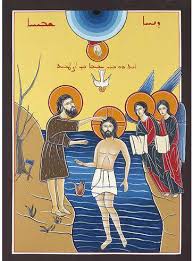
Feast of the Epiphany falls on 6 January, and inaugurates a Season which runs until the three weeks of commemoration of the departed, the immediate prelude to Lent.
The icon gives this feast its proper Syriac name, the denHo. This means “the rising of the sun or stars, sunrise, dayspring; brightness, light.” Metaphorically, it refers to “the shining forth or manifestation of the Lord in the flesh.” The 3eedo d.denHo is the Epiphany, the Greek word for “manifestation.” Therefore, the Syriac term for this feast and its season is a more comprehensive word than the Greek. The fact of the matter is that no one really understands what the English means: there is even uncertainty is the Latin Church whether it refers to the worship of the Magi or the Miracle at the Wedding at Cana, too.
But to see this feast as the “Rising of the Sun” is to illustrate in one simple phrase what it should emotionally mean to us. To think of it as the “Rising of the Star” is also appropriate, and should lead Christians to reflect on the prophecy that “there shall come a Star out of Jacob, and a Sceptre shall rise out of Israel …” Numbers 24:17. It also reminds us of the Star of Bethlehem, and indeed, in typology, all these stars are manifestations of the one star. In other words, in Syriac thought, the feast of the Epiphany reminds us that the Lord Jesus is the source of all light, and especially of spiritual light; He is the true sun, the true star; and when we see these in the heavens, we do well to lift our hearts to Him, too.
To recap, this feast is called the “epiphany,” “manifestation,” and “sunrise” because it is when Our Lord, who had been living quietly in his Nazareth home appeared before all the world. To us, we also see it as the first public manifestation of the Trinity.
When he prepared this icon, Fr Badwi had before him four ancient examples. Three of them are very close indeed to this icon. When we contemplated the icon of the Annunciation to Our Lady, we saw that the water in the well was drawn as if it was standing up all by itself. These three icons had something exactly the same with the river: it stands up from the ground like a pyramid, so that the head of the Lord is barely lower than that of St John the Baptist. Of this icon, Fr Badwi writes:
The Trinitarian element is represented: the Father by the chirophany (the appearance of His hand), which is a symbol not only of the Creator but also of His voice. He is seen by His incarnate Son, baptized in the Jordan by the Forerunner. The Holy Spirit, in the form of a dove, descends from the heights and rests on the head of the Son. The angels hasten to carry towels to dry the Ember who has been baptized, symbolized by the flame coming out of the water. This is unique to the Syro-Maronite tradition. The fire and the water are the image of the divinity united to the humanity through the person of the incarnate Son of God in the perfection of His two natures.
This feature of the divine nature as fire is shown very clearly in the Rabboula manuscript, where along the right hand side of the picture, we see the Father’s hand pointing down, directly beneath it is the dove of the Holy Spirit, and directly beneath that is the pillar of fire which is ascending from the River Jordan where the Lord is being baptised. Here, Father Badwi has done something a little differently. He has drawn the seven fold sphere of heaven in the top middle of the icon, giving it the most important position, showing that all which unfolds beneath is being directed by God. To the right and left of the seven heavens are written the words “the Glorious DenHo.”
The Father’s hand is slightly but unmistakably titled towards the right of the viewer because the Lord Jesus is seated on His right. Beneath the hand of God are the words “This is my beloved Son.” This shows that the hand of God also represents his Word – both are ways of understanding the creative power of God (which is One in itself, as all in God shares in His Oneness). The Holy Spirit has descended, and now overs the head of the Son. The fire to which we were referring seems to float above the water, almost as if it were a flower on the surface of the river. This also ties in with the Maronite theme that when Our Lord was baptised, spiritual fire filled the water, and all the waters in the world were purified.
The axe by the tree which is behind St John the Baptist is also important: he said that when Pharisees and Sadducees came to the River Jordan to be baptised, St John said to them: “Produce good fruit as evidence of your repentance … every tree that does not bear good fruit will be cut down and thrown into the fire” (3:8 and 10).So when we read this icon from left to right, we begin with the need for repentance for our sins, and the warning that the tree of evil is about to chopped down. Then we come to St John the Baptist, who is wearing rough clothing to signify his own poverty and mortification of the body, and then, in the middle, Our Lord, being baptised. To the right are the angels who are there to tend to Him. The presence of the angels reminds us of the words of St Matthew, who immediately after the baptism of the Lord, as His temptation in the desert, which ends with these words: “… and behold, angels came and ministered to him” (Matthew 4:11).
Of course, the angels also represent heaven, and therefore salvation. So reading the icon from left to right, we have this sequence: penance, the Lord and His sacraments, the angels of heaven. Not every icon can be read this way, but when the icon tells a story, it often will be that way.
1.04.2021
The Nativity of the Lord
by
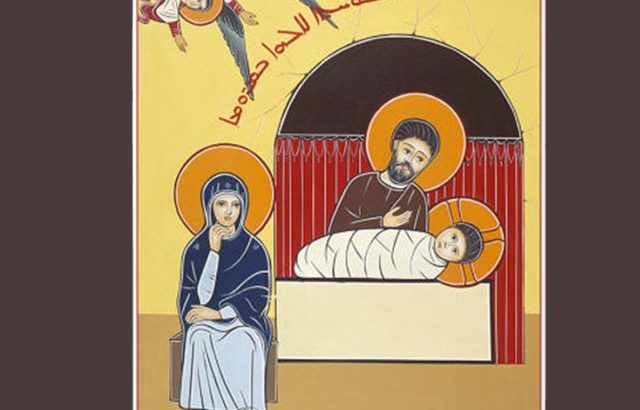 Christmas Icon was produced after the manner of the Rabboula manuscripts. Fr Badwi writes: “The Blessed Virgin is seated with her hand on her chin, thinking and meditating on this great event, the miraculous birth which initiates the history of salvation. She is modelled on the Muse of History in Greek mythology. Near her lies the wrapped child, in the form of an altar and tomb. He is born to be sacrificed and to die for us. Joseph the Just is respectfully inclining behind the manger. The grotto and the veil stand for the grotto in Bethlehem, despite their unrealistic form. Angels trans-pierce the celestial circle, singing “Glory to God in the Highest,” written her in Syriac.”
In Liturgical Year Iconography, he reproduces some ancient illustrations he used in preparing this icon. Fr Badwi has very carefully managed to include all the important details, in so neat and orderly a form that we do not notice how much has been packed in. Compare this icon to the other Nativity Icons that come up on a web search, and you will see how uncluttered and clean it is.
First, centre stage is held by the Christ Child in swaddling bands. Today infants are wrapped in bunny rugs, but in the old days they were “swaddled,” or kept tight and warm by using strips of material. It was known in those days that the best way to keep warm is not have thicker coverings, but to use more coverings, because these trap the air between them, and that warm air is the best protection of all. Notice how the Christ Child lies on the cradle: it is presented as if it were an altar, and he the Holy Offering upon it.
An altar is integrally related to a tomb, because it is a place of sacrifice; where life on one level is exchanged for life on a higher. But because it is that type of tomb, the altar is a tomb which points both to resurrection and to death. The altar is a tomb where death is not just reversed into life, but is raised into a higher life.
The next figure after the Lord, is surely St Joseph, who is bending towards his foster son in a simple and dignified gesture of piety. He is both gesturing to the child and also to his own breast, as if he is saying: “This child is in my heart.” The Lord’s eyes are looking directly at us, but St Joseph’s and Our Lady’s eyes are gazing across our right hand side of the icon. The angels are looking down, diagonally, and across, but not at us. We are engaged, in this icon, by the Christ Child and by Him alone. He is absolutely the centre, and His halo is already marked with the sign of the Cross, while those of the other holy figures are plain.
Note that behind the Lord and His foster father, there are cracks coming from the top of the arch. Remember that these represent the grotto in Bethlehem. The veil, which Fr Abdo refers to, is also the veil of the Temple which will be split when the Lord dies on Good Friday (Matthew 27:51; Mark 15:38; and Luke 23:54). Hence, I suggest, the cracks, because from the moment of the birth of the Lord, the old order is being prepared to pass away, having fulfilled its divine purpose, and being fated to be surpassed and superseded by the New.
When Fr Badwi writes that Our Lady was modelled on Clio, the Greek Muse of History, he must mean in the calmness of her expression. I have looked at a number of illustrations of her from ancient Greek art, and in none of them is she shown in this pose. Usually, she is shown with a trumpet, or with her right hand raised, and a finger pointing upwards, for she is known as “the Proclaimer,” since history makes great events known. Yet, Clio herself is not shown as excited or emotional. The one who reads history must read carefully and attentively, not being swept away by their feelings. This does fit in with the image of Our Lady as being the one who pondered all these things in her heart (Luke 2:19 and 51, although to be fair to St Joseph, St Matthew tells us that he too pondered what he had seen: Matthew 1:20).
And this brings us to the very greatest difference between this depiction of the Nativity and any known to me from the Western tradition. There are very few, practically no, representations of St Joseph tending to the child at the crib, while his mother is sitting before him. There are of course many depictions of St Joseph holding or nursing the infant, but almost never with Our Lady present, but watching rather than participating in the scene.
Yet, this feature is shown in the ancient example from the Rabboula manuscript which Fr Badwi gives as an example of the illustrations he used in preparing his icon. So, even in the Syriac tradition, there was a tradition of depicting St Joseph tending for the Infant Jesus as he lay in his swaddling bands, as Mary sits apart meditating. Why?
I suggest that here Our Lady is the middle, between the angels who appear from out of heaven on high and her husband. She does not know all that the angels know, but she does realise that she is present before a very great mystery, and so she seeks understanding. Our Lady’s posture is a reminder not to allow ourselves to become lost, even in the adoration of the Lord. We are not made to lose ourselves in worship, but to find ourselves in contemplation of the divine.
Finally, one another strange feature is found both in this icon and in the Rabboula original, but never in Western art: the Infant Jesus is depicted at approximately two thirds the size of the adults. He is still a child, but he is more. I think the reason is that he is already complete in his divinity, although as a human he still has to grow. There was a feature in ancient art where the most important figures (e.g. a king) were always depicted as larger than the others. This depiction of the child as extraordinary in size is done with the same feeling: but he is not shown as larger than the adults, only as preternaturally big for a baby.
So there are two rather unusual aspects in this aspect which only come to light when we meditate on it: the reversed positions of St Joseph and Our Lady from what we would expect, and the disproportionately large depiction of the Lord. These things have a feeling impact on us, even if we cannot always explain why. They make an impression.
12.13.2020
The Revelation to Joseph

When Fr Badwi writes of a “Rabbulian frame,” he means the way that the icon is bordered by two columns supporting a canopy in the Rabbula Gospels. Here the canopy is depicting the night sky, hence in the top left and right hand sides, we see two stars rather than the sun and the moon. The “celestial circle” is the region of heaven. Here it is shown as a large circle, with inner concentric circles: heaven was believed to have seven levels. The angel is appearing from behind the spheres.
There is a direct line between the open eyes of the angel and the face of the sleeping St Joseph , whose had seems to float just a little above the pillow. His body is lying on the bed, but his mind has been lifted above the earthly level. There is an important lesson in this: in order to contemplate divine realities, we have to be grounded on the earth, but our eyes are closed to the impressions of the world to perceive the divine light, and our intellects lifted above any earthly thoughts so as to receive the mind of God.
Notice the red of the angel which is shaped like a flash of lightning or a flame of fire. Well, it is a flash of lightning, and it is a flame of fire. St James of Serug wrote of the angel who appeared to St Joseph: “The spiritual one flew and reached him swiftly to drive away all doubtful thoughts from him. In the vision of the night he approached towards him … so that in fright and with caution he might accept his words. A perturbing appearance, glorious and amazing, did he reveal and made manifest to him so that he might fearfully hear the truth from him. He blew like wind and flew on high like lightning and reached him. He was inflamed with fire, resounded like thunder and spoke with him. He became a man and brought forth lightnings from his flame.” (First Homily on the Nativity, lines 699-707). When the angel appears to St Joseph, the entire house was filled with a “cloud of fire.” We tend to think of the angel appearing like a postman with a message. But St Jacob, understanding better the nature of angels, has him assume a fearsome human form so that the splendour and power of his appearance would be its own guarantee of truth. It is a very different way to think of the angel’s appearances to Joseph.
St Jacob also adds to the Gospel accounts, the angel saying to St Joseph: “Behold, God is united with man as was proclaimed: God is with you.” (733-734). We Maronites recall these words in every Mass when the priest prepares the offerings: “You have united your divinity with our mortality, and our mortality with your divinity …”
When we think of St Joseph, we remember that he bears the name of Joseph the son of Jacob in the Book of Genesis, and like him, received dreams. Rather, according to Syriac thought, it is Joseph the son of Jacob in the Old Testament, who is named after Joseph the son of Jacob from the New Testament, the foster-father of the Lord. Consider this, in Matthew 1:16 we read: “And Jacob begot Joseph the husband of Mary, of whom was born Jesus who is called Christ.” Is that a coincidence? According to the typological way of thought, the events of the life of Christ are the very centre of history, and all of history, whether it happened before His lifetime or afterwards, takes its meaning from His life.
To our minds, which can only understand time as a line, Joseph the husband of Mary comes after Joseph the Dreamer. But in eternity, there is no arrow of time: our lives, like all of time, are only a moment in the mind of God (so to speak). That is, from the perspective of God, there is no before or after in time.
It is often asked: did St Joseph ever know Our Lady as a man knows his wife? People often find an ambiguity in the Gospel account. But the Maronite tradition is clear: the answer is no. This is an ancient tradition. St Jacob, for example, had no doubt at all. He wrote that St Joseph said to Mary: “God forbid that I should turn to marital union with you … to your purity I am submitting myself because your Son is my Lord” (758 and 762).
Another point which St Jacob notes is that, for the sake of Mary and her divine son, Joseph “endured ignominy” (a bad reputation) (1022). Coming from the same cultural world as that in which Our Lord was born, Jacob understood very well that St Joseph, as the husband of a woman who became pregnant while in her father’s house, would himself have had a bad name. In the Third Homily on the Nativity, St Jacob wrote: “O Joseph, come, show us the Father of the Child since you are treated wrongly because of Him and the truth calls out that your are not His father.” (300-301) This is an overpoweringly beautiful thought: that because Joseph was not the Father of his own foster-child, but accepted this, he can show us the true Father.
It is extraordinary to think that if St Joseph had not done as he did, Our Lady might even have been put to death because it was thought she had committed adultery (Third Homily, 309). Let us close with this meditation from the poet: St Joseph says “I am guarding him as my son, the Hidden Mystery.” Then, adds St Jacob: “Words fall silent …” (w shalyon mele), line 314.
12.07.2020
The Birth of John the Baptist
by
Luke 1:57-66 Now Elizabeth’s full time came for her to be delivered, and she brought forth a son. When her neighbours and relatives heard how the Lord had shown great mercy to her, they rejoiced with her. So it was, on the eighth day, that they came to circumcise the child; and they would have called him by the name of his father, Zacharias. His mother answered and said, “No; he shall be called John.” But they said to her, “There is no one among your relatives who is called by this name.”
So they made signs to his father—what he would have him called. And he asked for a writing tablet, and wrote, saying, “His name is John.” So they all marvelled. Immediately his mouth was opened and his tongue loosed, and he spoke, praising God. Then fear came on all who dwelt around them; and all these sayings were discussed throughout all the hill country of Judea. And all those who heard them kept them in their hearts, saying, “What kind of child will this be?” And the hand of the Lord was with him.
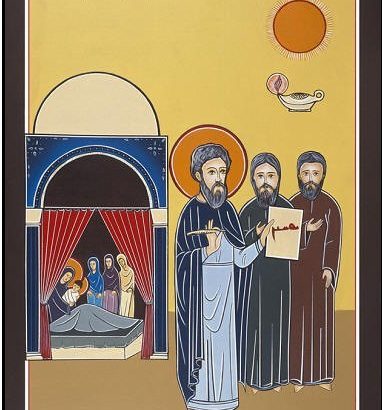
Fr Badwi writes of the icon: “This icon unites two events – Elizabeth in her home carrying her new-born son, surrounded by midwives and neighbours; and Zechariah writing the name “John” in front of two of his friends. In the miniatures of the British Library … and the Vaticanus Syriacus … the second event is only represented. We have added the lighted lamp in front of the sun, the symbol of the Baptist in front of Christ, according to the Syriac liturgical texts.”
The name is written in Syriac in this icon: “Yohanon.” Of course, Christ is the sun, and the Baptist is the lamp.
Once more, a dome is present, this time over the house where St John the Baptist is born. This could be because the Temple was in Jerusalem, which is in the hill country where St John was born (after all, his father was a priest who served in the Temple). But I think there may be more: the Temple is a model of the Church of God. Every house where God is worshipped shares in the holiness of the Temple and of the Church. Hence, the dome was present over both the houses of Our Lady and her cousin in the icon for the Visitation (the Journeying of Mary). Obviously, the Temple cannot be in two places at once, but the reflections (or in theological language, the antetypes) of the Temple can be in many places simultaneously. In this way, the Church is one in heaven, and it is reflected in many “copies” on the earth. Elizabeth’s house is shown in the same manner, even with the same colours, as Our Lady’s in the icon of the Annunciation. They seem to be the one house: and they are, in their holiness.
Finally, from the icon, the curtains of the house are pulled back, for the birth of the Baptist was the topic of conversation in that area. St John is wrapped in swaddling bands, as the Lord would be. Also, Zechariah is walking forward towards the two men (two men were needed as witnesses in the Hebrew tradition), which is shown by the lifting of his right foot: he is intervening to ensure that the child is named “Yohanan,” or “God is gracious.”
Interpretation This is the fourth Sunday of Announcement. What is being announced today? It is partly the birth of St John the Baptist, partly confirming that the woman who had been thought barren has been found fertile (hence the sprouting from the withered tree trunk which we saw last week). But above all, the announcement is that the hand of God is operating in our world. This is shown my multiple factors: the miraculous birth itself, Elizabeth’s choice of a name which no one had expected, the confirmation of her choice by Zechariah, and the curing of his inability to speak, and that both Elizabeth and Zechariah attributed the miracle to God through their naming of the child.
Fr Badwi was quite justified in deciding to show not only the events with Zechariah, but also the birth of the Baptist. The two events go together, and give each other meaning. Perhaps the old icons only showed one event because the icons might otherwise have been too full, with too many details. When we considers it from that perspective, we see how capable and judicious Fr Badwi’s icon is. It manages to show the two events with great clarity.
How do we interpret all this? When we consider all the miraculous events together, we see that God is truly the Lord of History. He uses unexpected people, and unexpected events, to bring His Divine Will to come to pass. Like the people in today’s Gospel, we think we have a pretty shrewd idea of what is happening and what it likely to occur. But are we justified in this? These people thought they understood Elizabeth and her condition: they thought that her barrenness was because she did not enjoy the favour of God. Their beliefs were completely overturned: it was precisely because she was a good woman and was to receive the favour of God that she was kept barren until such time as her giving birth would show forth the glory and power of God.
So too, we should be humble when we look at the world around us, or contemplate the direction our lives are heading. We might think that God has forgotten us, that He is not listening to our prayers. But if we did think that, we would be wrong. First of all, if one prays to Him, God will always grant us the grace to deal with whatever the issues before us may be. But secondly, and shown very clearly by this Gospel: history and our lives are not in our hands, they are in the hands of God. He knows better than us what we need and when we need it. He knows better than us His own Divine Plan for the Salvation of His People. Rest assured that He will bring His salvation to come to pass – and the way He does it will surpass the workings of our small minds.
12.02.2020
The Visitation to Elizabeth (Mary’s Journeying)
by
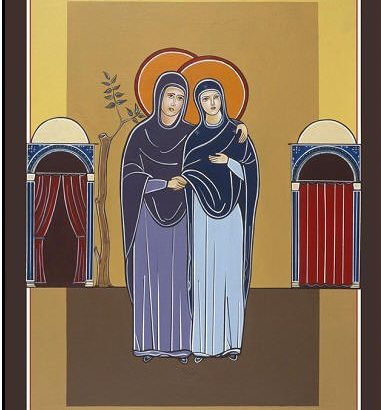
Journeying, or in Western Christianity, the Visitation of Our Lady to her Cousin Elizabeth is the third week of the Maronite Season of the Nativity or the Announcement. It is a little surprising to realise that in the Syriac interpretation, this Sunday is an integral part of the Season of Announcement, not only because it follows the announcements but more deeply because it is itself the announcement of the Incarnation to Elizabeth and to John the Baptist. The emphasis in the Syriac tradition is not on visiting, it is on travelling to proclaim the conception of the Lord.
In other words, the Syriac presents Our Lady as the first apostle, the first to be sent forth to declare the mystery of salvation. Just as “apostle” means “the one sent forth,” so in this week we honour Mary as “the one who went forth.” This is the very meaning of the Maronite icon: it is called mi.zal.tō d.mar.yam, meaning “Mary’s Journeying.” The word mi.zal.tō means “journey, departure, pilgrimage.” It can even be used of the final voyage, into eternity. It actually does not mean “to visit:” that is another word altogether in Syriac, s.3ar “to visit, inspect,” which is used, for eample, when visiting the sick. When a chorepiscopus visits his area, that is a sō.3ou.rou.tō, or “visitation.” The noun mi.zal.tō however, comes from an entirely different verb, e.zal, which means “to go, walk, journey.”
Now, of course, a person who makes a visit does also go on a journey. But not at all who go travelling are visiting. Further, the emphasis is different: in the case of visiting it is on one person dropping in on another – at least two people are directly concerned in a visit. However. when we speak of a journey, only one needs to be involved. That is, the emphasis is quite different: in one instance we emphasise that the traveller has gone forth, and we draw attention to her journey. In the other, we emphasise the meeting.
Why, when the Syriac mind contemplated this episode from the Gospel of St Luke, would it think of Mary’s making a journey as the more revealing title than the fact of her visiting her cousin? One reason might be that the Syriac New Testament reads like this: qō.mat deyn Mar.yam b.houn b.yaw.mō.tō hō.noun: we. zalt b.Tee.lō.yeet l.Tou.rō lam.deen.tō dee.houd (Luke 1:39). “She arose, Mariam, in those days, and she journeyed instantly to the mountain, to a town of Judah”, the verb “to journey” being e.zal. So, in calling this episode “Mary’s Journeying,” the Syriac tradition follows the text of St Luke very carefully indeed. In neither the original Greek nor the Syriac, do we find either the words “visit” or “visitation.”
But I think there are two further reasons: the first is found in the Maronite Beit Gazo, a treasury of medieval Maronite hymns and religious literature. Fr Badwi quotes this part of it:
The young girl whispered gently in the ears of the aged woman.
The voice crept in, entered, and impelled the Forerunner of the Truth (John the Baptist).
The child leaps for joy before the Son of David (Jesus),
(David) who danced in front of the Ark.
He kicks his mother to go out, and to adore,
so that his Lord who has come to visit him is not kept at the door.
This passage is taken directly from St Jacob of Sarug’s first Homily on the Nativity, 497-502. I have consulted both that text and the Syriac in Beth-Gazo Maronite Add. 14.701. The passage is not an easy one in the Syriac, but the overall meaning is clear, and is fundamental to Syriac interpretations of the Journeying (Visitation): Mary is the Ark of the Covenant, and her journeying to Elizabeth is the type of the journey of the Ark of the Covenant in the Old Testament.
In 2 Samuel 6:9-14, we read: “David was afraid of the Lord that day; and he said, “How can the ark of the Lord come to me?” So David would not move the ark of the Lord with him into the City of David; but David took it aside into the house of Obed-Edom the Gittite. The ark of the Lord remained in the house of Obed-Edom the Gittite three months. And the Lord blessed Obed-Edom and all his household. Now it was told King David, saying, “The Lord has blessed the house of Obed-Edom and all that belongs to him, because of the ark of God.” So David went and brought up the ark of God from the house of Obed-Edom to the City of David with gladness. … Then David danced before the Lord with all his might …”
Here the Ark of the Covenant (the box containing certain holy items, and being a sign of the presence of God) is taken for three months because of David’s fear before returning, and brings with it blessings. In St Luke, the Ark of Covenant, Mary, bearing the presence of God, goes to her cousin’s house for three months, fearlessly making the arduous journey, and brings with her blessings. St Luke is showing us the true meaning of the Old Testament stories, and how all of sacred history, read typologically, shows us the Lord.
The Icon
Fr Badwi’s icon was based on an ancient Syriac picture available in the Vatican Library. The Virgin and her cousin stand in front of two houses: the Virgin’s house with a closed veil, symbol of her virginity, and nearby, Elizabeth’s house. In front of Elizabeth’s house is a fry tree, which would appear to be dry and withered but for the green branch sprouting from it. This is, Fr Badwi explains, a symbol of the barren woman who will give birth.
I would add that, although Fr Badwi has placed in front of Elizabeth’s house, the dry tree with the green branch unexpectedly sprouting, it could quite rightly have been placed in front of both houses, for St Ephrem writes in his first Nativity Hymn: “The staff of Aaron sprouted, and the dry wood brought forth – his symbol has been explained today – it is the virgin womb that gave birth” (line 17). Ephrem is referring to the story in Number 17 where, during the Israelite wandering in Sinai, twelve staves of twelve leaders were deposited in the Tent of Meeting. The next morning, Aaron’s staff had produced blossoms and ripe almonds, showing that the Lord had chosen Aaron and his sons to be responsible for the priesthood (Numbers 18:1).
Now, St Luke tells us that Elizabeth was of the house of Aaron (Luke 1:5). So the dry tree which miraculously blossoms is a fit sign of her. But, the ancient system of thought which we call typology can handle this: the tree which gives forth life when it did not seem possible is both aged Elizabeth the daughter of Aaron who had been barren, and the young Mary the daughter of David who was ever-virgin. And so the houses of Aaron and David, the kingship of the one and the priesthood of the other, the old and the young, the hills (Elizabeth) and the plains (Mary) are brought together in one mystery. Words cannot explain this uniting of opposites and differences: but the symbolism of the artist can present it to the eyes so that it can be read by the faithful soul, interpreting by the light of the Spirit.
11.24.2020
The Announcement to Mary

The Announcement to Mary is the second week of the Maronite Season of the Nativity or the Announcement. When we discussed the Announcement to Zechariah we said something about the calendar and its seasons. Let us go deeper into the annual seasons: the cycle of feasts, fasts, and celebrations presents to us a complete course of the life of the Lord, of salvation history, and of our situation between time and eternity.
If we prayerfully follow the calendar, our minds and hearts are gently turned, week by week, to witness another aspect of God’s action in history; we deepen our knowledge of the Lord, His blessed mother, and His saints; we ponder the mystery of death on the Sundays of the Deceased, and we join in the sadness of the Passion and the joy of the Resurrection.
If we prayerfully follow the calendar, we will always have food to nourish us: food which is familiar but also varied. We have our regular devotions, but not those and nothing else. Just as physically we need a balanced diet, so too, in the spiritual life, we need a balanced diet of prayer. Sorrow in its right time, joy in its right time, teaching of virtue and warning against evil; expectation and fulfilment. The feasts of the calendar deliver all these to us. They present the whole of the faith in a sane and accurate way: the emphasis on God the Holy Trinity, but not forgetting the angels and saints; and we remember saints of many different descriptions: martyrs, scholars, men and women of action, clergy and laity.
The liturgical calendar gives us a direction through the year, and it provides us with balanced spiritual nourishment.
The Announcement to Mary
Once more, let us begin by contemplating the icon painted by Fr Abdo Badwi. It is closely based on five ancient icons. They are all strikingly similar, and yet they are all distinctive.
Fr Badwi wrote of this icon: “The Announcement to Mary is one of the oldest themes in Christian iconography. This icon is from the same inspiration as the previous one (the Announcement to Zechariah). The Virgin is standing in front of the veil of the Temple, symbol of her virginity because she is the Temple in which the Lord was pleased to dwell, whilst maintaining her virginity. She is pulling out a string (thread) from the basket (at her feet). According to the tradition, she is weaving the veil of the Temple with the chosen virgins. Her hand gesture is a sign of reception and submission. There is a spring and a water jar near her. She preserves the water of life and gives it to us. Another Syriac tradition places the Announcement near a well. The Archangel carries a pilgrims’ rod in his left hand, and greets her with his right hand. The Holy Spirit, in the form of a dove, is a later tradition in iconography.”
At the top of the icon is written sbartō d.yōl.dat a.lō.hō, meaning “The Tidings of the Mother of God.” As with Zechariah, s.bar.tō or “good tidings” links this feast to the Gospel of the Lord Jesus Christ.
The Holy Spirit enters from the top left hand, just as the angel is shown on every single one of the five ancient icons, and this one, entering from the left. The divine therefore encounters us from other dimensions. The Holy Spirit enters from the upper left, while St Gabriel the Archangel, enters from the middle level. Note, his right foot is raised, and his left foot, which goes before him, is flat. So he has arrived from the left, but he is standing higher than the level of the jar which is catching water from the well. So, although Gabriel is addressing Our Lady from eye level, he is in fact walking on the air, and she is standing on a platform. That is, although the divine messenger comes to us, and speaks to us on our level, yet he in himself belongs to the higher world.
Our Lady stands beneath the cupola of the Temple, and behind her is the veil of the Temple. As Fr Badwi said, she is weaving that veil. There is a very ancient Christian legend, known as The Protevangelium of James, although its true name may have been The Genesis of Mary. It is the oldest surviving sustained Christian study of Our Lady. By telling her story, it provides more reverent and uplifting teaching about her than three volumes of theology ever could. It is the oldest source to tell us that her parents’ names were Joachim (Yuwakim) and Anna (Hanna).
It also tells us that Our Lady was living in the temple complex, and worked at the weaving of the veil of the Temple – the veil which separated the holiest part of the Temple, protecting it from the entry of the impure and unholy. That was the very veil which was rent in half at the death of the Lord on Good Friday. This gives evidence of the very deep thought and spiritual understanding which went into this story, because it connects her action of knitting with her conception of the Lord and His formation in the womb; and it connects the end of her handiwork (the veil) to the death of the Lord. It also connects the Lord to the Temple. In other words, possibly as early as the second century A.D., Christians had been given the grace to understand that Mary’s work was at the end of the Old Covenant and the birth of the New, that by her acceptance, the Temple (the world) was brought to its greatest perfection, and it was embodied in the Lord who died, but by dying, made life eternal. They understood that where the divine and the earthly meet, there is a curtain: the curtain hides, and it reveals: one cannot see past it, but seeing it, one knows that something is hidden. And so the search is over when we reach the final veil, because behind that veil is God.
In terms of Syriac typology, what the Genesis of Mary is teaching, although as a tale rather than as a catechism, is that Our Lord is the true Temple, and because the Temple is the Universe, He is the essence of all the Creation. This also means that when we read the Bible, we can read Our Lord as the Temple, and as all the creation. There is a wide Creation and Temple-theology related to this, but I wish to pass on to just one more feature: the well and the replete jar.
Why, in five out of our six icons, does the iconographer draw the well as if it were a sort of tunnel of blue emerging from a box? That is not how wells look: they are openings in the earth, and in the ancient Near East, they were often circular brick structures with a rope going over the side so that buckets can be lowered in. So why this strange way of drawing the water?
I think that the answer is found in ancient Egyptian art. Although the Egyptians usually depicted water by drawing wavy lines, when they drew pools and wells, they were often depicted similar to what we see in this icon. They usually painted objects by showing them not as we see them when looking at them, but as we do when thinking about them: e.g. showing the entire eye, and not just the little part we see. So here we see the surface of the water, even though it is shown unrealistically above the level of the jar, as if it dripping water into the jar, when in fact the jar would have to be lowered into it. In Reading Egyptian Art, Richard H. Wilkinson explains that water was, for them, “the primeval matter from … all things arose; and the pool could thus signify the primeval waters of the First Time” (137). I think this gives us another clue to the reason water is shown here: according to typology, the waters of the earth are the waters of the creation – and the Lord is about to be incarnated, created in human form. In the presence of Mary, the jug is being filled: the creation is flowing from the source into this world in a special form.
Just as the wool took form as the veil of the Temple, so the water takes form when it flows into the jar. So too, the Lord takes form in the womb of the believing maiden. This icon, then, is an icon of the mystery of creation: through the Holy Spirit, through water, and by the faith of the Virgin.
10.23.2020
The “Our Father” in Syriac, with Notes
The “Our Father” in Syriac, with Notes
Aboun d.baš.ma.yo
Our Father, who (is) in heaven
net.qa.daš šmokh
Let it be hallowed, Thy name
tee.te mal.kou.tokh
Let it come, Thy Kingdom
neh.we Seb.yo.nokh
Let it be done, Thy will
ay.ka.no d.baš.ma.yo off bar.3o
As in heaven, so on earth
hab.lan laH.mo d.soun.qo.nan yow.mo.no
Give us (that) bread which is necessary, today
waš.buq lan Haw.bayn waH.to.Hayn
And forgive us our debts and our trespasses
ay.ka.no doff H.nan šba.qan l.Ha.yo.bayn
As we have forgiven our debtors
w.lo ta3.lan l.ness.you.no
Lead us not into temptation
e.lo fa.So men bee.šo
But deliver (us) from (the) evil (one)
me.Toul d.dee.lokh mal.kou.to
For Thine is the Kingdom
w.Hay.lo w.teš.bouH.to
and the power and the glory
l.3o.lam 3ol.meen, Ameen
For ever and ever, Amen (Let it be made firm)

9.12.2020
The Feast and Season of Holy Cross
by
The liturgy is absolutely fundamental to Christianity: the New Testament shows the Church as a worshipping community, gathering for the adoration of God, the climax of which is the Eucharist. The liturgy is not a man-made add-on to the faith: it is of its essence, and its feasts are major signposts for the Christian and for the Church. This feast, celebrated on 14 September, was established to commemorate how, in 628, Emperor Heraclius recaptured the Cross which the Persians had stolen in 614. On this day we also commemorate the finding of the Cross by St Helena in 326, and the subsequent dedication of the Church of the Holy Sepulchre. It is therefore an occasion to remember in prayer four matters: the Holy Cross itself and all that occurred in relation to it, namely, the ... Read More click on photo

8.14.2020
The Assumption Of Our Lady Into Heaven

Why do we celebrate each year, on 15 August, the Feast of the Assumption of Our Lady into heaven? And why is it the greatest of the feasts of Our Lady? Why not her birth, or the Annunciation, or the Immaculate Conception?
The truths of the faith form a coherent unity, like how the woollen threads of a cardigan are knitted together: they make one garment with one function. The cardigan is to keep us warm, and the faith is to teach us the commandments of God our Creator so that we may be reunited to Him: imperfectly in this world, but God willing, more perfectly in the next.
Like the threads of a cardigan, the truths of the faith can only be separated one from the other by destroying the whole. Remove one thread, and with time, the whole cardigan will fall to pieces. So too, one begins with rejecting just one part of the faith, but, bit by bit, it will all be lost to us. Some threads of the cardigan are more central than others, and pulling them out will cause it to lose its shape more quickly.
The Assumption is a central thread in the garment of the faith. It is intimately connected to the doctrine of Our Lady as the Mother of God. This is the reason for the Assumption: the Lord could not leave His own mother on the earth to suffer corruption of the body which had borne Him, the King of Creation.
We cannot understand the magnitude of Our Lady’s obedience to God: this is the only reason we are not lost in wonder at it. When the Archangel Gabriel appeared to her, and gave her the message from the Most High, she knew only that a miracle would be worked so that she would bear a son in circumstances which no one on earth could possibly understand; that a virgin would become pregnant and give birth. We rarely stop to think about it, but it means that her own life was over in that it would take a course which no life on earth had ever taken before. She willingly became completely subservient to God’s plan in a way she could not comprehend. After all, what it would mean to tell a young woman that she would conceive when the Holy Spirit overshadowed her?
In every single Mass we confess this great mystery of how a mortal woman became the Mother of God. As stated, this is why she was assumed body and soul into heaven. This shows how the Assumption is closely tied to Mary’s being the Mother of God, and how to lose one teaching is to lose the other.
The Assumption is the earthly conclusion of the cosmic drama which began with the Annunciation to Mary the daughter of Saints Joachim and Anna. No other ending of her earthly life could possibly have done justice to the epic news announced by the angel.
Therefore, if we let go of these doctrines, then we also lose the Incarnation of the Lord. It is because she, a lady of flesh and blood was His Mother that we can say Our Lord was truly human as well as truly divine. If Mary was not the Mother of God, then she was the mother of a man. This is exactly what has happened in many non-Catholic and non-Orthodox groups. They have rejected any devotion to Our Lady at all, therefore have no conception of her being the Mother of God, and so came to see Jesus Himself as being only a man, and not God. After all, no one denies that Mary was His mother. But if they reject the Virgin Birth, then they reject the foundation of the full divinity of the Lord. It gives me no joy to criticise others, but I must point out the logical and historical consequences of rejecting any part of the one truth.
Even if the first ones to deny that Mary was the Mother of God still thought of Our Lord as being divine, it was only because they did not think through the consequences of their own fundamental premises. Well, even if they did not think it through, their children and grandchildren have, and so belief in Jesus as true God and true man has been in steady decline in the Christian world since the Protestant Reformation, so that now He is often seen as being no more than a good man and wise teacher. It does not matter if someone says that He was the best of men and the wisest of teachers: it still leaves Him as only a man and a teacher. And so they feel free to change the faith to accord with their own ideas: they have made their assessment of the Lord, why not assess his teachings for themselves?
Let us move on. If we look at the Assumption, it is not possible to draw any conclusion other than that Our Lady lived a life of the greatest virtue and holiness, and for this was worthy to be taken into heaven. Had she sinned, this would not have been possible, for she would not have been an example of her own Son’s teaching. And in this the Assumption is a type or pattern for all humanity. If we too live as virtuously as possible and in the greatest holiness we can, we may be able to hope that we too will be saved. We cannot match Our Lady for purity and love, so we cannot expect to be assumed into heaven. But the type of thing which Our Lord did for her, He may, in His infinite mercy, do for us, as well. So, if we lose the teaching of the Assumption, we lose the reward of virtue and the punishment of evil. Again, those groups which have lost the Assumption have started to lose their faith in eternal reward and eternal punishment, which means in eternal justice. And if there is no eternal justice, then God is not God. He is well-intentioned, but weak (or else a tyrant). And so the whole of the faith disintegrates.
In both Eastern and Western Churches, many more connections between Our Lady and the faith are made by typology. We all see Our Lady as the second Eve. As St Jacob of Serugh states: “The second Eve gave birth to Life, among mortals; she wiped clean the bill of debt incurred by Eve her mother. The child (Mary) gave her hand to help her aged mother (Eve) who lay prostrate; she raised her up from the Fall that the serpent had effected. It was the daughter (Mary) who wove the robe of glory and gave it to her father (Adam) …” (trans. S. Brock).
Yes, if we celebrate the Assumption with devotion and understanding, I do not think we can lose our faith in her as Mother of God, in the Incarnation, in the true divinity and humanity of the Lord, and in His teachings, the necessity to follow His commandments, and the justice and goodness of God Almighty. I have not had space to draw other more directly spiritual lessons from this Feast, but God willing, I shall do so in the future; for as stated, the faith is one garment, an organic, coherent, and splendid unity: like the light of an infinite sun which illumines all that has been, is, and ever shall be.
8.01.2020
The 350 Martyrs: Part I
The 350 Martyrs: Part 1 (The Holy Martyrs)
On 31 July each year, the Maronite Church remembers the 350 Maronite monks who were martyred in the year 517, slain by other Christians for no other reason than being orthodox Christians.
 In The Maronites: The Origins of an Antiochene Church, Abbot Paul Naaman takes their history from a letter from the archimandrites, (that is, abbots and senior abbots), and monks of Syria Secunda to Pope Hormisdas (514-523). Syria Secunda was the inland part of ancient Syria, and Apamaea (Arabic: Afamiyya) on the Orontes River was its capital. (p. 43)
There is a second letter from the monks of Apamaea to their own bishops, also written in 517. This, too, is signed by Archimandrite Alexander of the monastery of Maroun. It states, as the first had done, that the purpose of the monks in travelling had been peaceful. There is also a reply from Pope Hormisdas dated 10 February 518. So, the evidence for the feast of the martyrs is based on three letters, a point which is often missed.
The first letter, the one to Pope Hormisdas reads, in part: “To Hormisdas, the most holy and blessed patriarch of the whole world, the holder of the See of Peter, the leader of the apostles, the earnest petition and humble prayer of the least (important) archimandrites and of other monks of your province Syria Secunda.”
“The grace of Christ, the Redeemer of us all, has instigated us to take refuge with your blessedness as if (taking refuge) from the winter storm in the stillness of a harbour. We are admonished to, and, indeed believe, that, even though disasters encompass us on all sides, we are in no way caught in. For even if we suffer, we endure it with rejoicing, knowing that the sufferings of the present time are not worthy of the future glory, which will be revealed in us.”
“(We have been opposed by) … Severus and Peter, who have never been counted among the number of Christians, who on each single day have attacked and publicly anathematized the holy synod at Chalcedon and our most holy and blessed father Leo. … when we were going to the cell of Mar Simeon for the cause of the Church, they (men instigated by Severus and Peter) were lying in wait for us on the way as it had been announced, defiling us, and when they came upon us by surprise, they killed three hundred and fifty men from among us, and certain ones they wounded; but others, who could take refuge to the venerable altars, they slew there and set the monasteries on fire, inciting throughout the night a multitude of unsettled people and mercenaries. They wasted all the poverty of the Church through destructive trouble makers of this kind. About the details, however, the writings may instruct your blessedness, which were brought over by the venerable brothers, John and Sergius, whom we had sent to Constantinople …”
“We pray, therefore, most blessed one, we go on our knees and ask, that you stand up with fervour and zeal and rightly have pity for the body that is torn to pieces (for you are the head of all); and that you avenge the faith that has been despised, the canons that have been trodden under foot, the fathers who have been blasphemed and such a great synod that has been attacked with anathema.”
Pope Hormisdas’ reply adds little to this. The opening reads: “Hormisdas, to the priests, deacons, and archimandrites of Syria Secunda.”
“I have read your highly esteemed letters, by which the insanity of the enemies of God has been laid open and the obstinate fury of the unbelievers, who with revived spirit hate the Lord and thereby wickedly persecute his members, has painfully been exposed. To the extent that it pertains to the recognition of your perseverance, I praise God that he preserves the faith of his soldiers in the midst of adversities.”
The third letter, from the monks of Apamaea to the bishops, was translated into German and French by Suermann in Histoire des origins de l’Église Maronite (PUSEK 2010). This letter blames Severus for what occurred as they were travelling through an area called “Kaprokeramée”. It does not mention the number slain and captured, but gives more details of how the monks could not defend themselves against the attacks (pp. 95-100).
The clash between Monophysite and other Christians arose after the Council of Chalcedon (451): to be brief, they had different ideas of the nature of Christ. Although only theologians could understand the argument (and even they may not have been clear about it), because these thinkers led their churches, they split Christianity into two bitterly divided factions, a rift which is only being slowly healed today.
In Part 2, I shall deal with an objection to the historicity of this account, and in Part 3, with the spirituality of this feast. Read More Here
Cornelia B. Horn, writing in the Journal of Maronite Studies, translated both the letter from the monks to Pope Hormisdas and his reply. Her article is still available on the internet: http://www.maronite-institute.org/MARI/JMS/october97/The_Correspondence_Between.htm
Joseph Azize, 2 April 2017 revised 24 July 2020
Subscribe to:
Posts (Atom)