Showing posts with label Christmas. Show all posts

1.04.2021

The Nativity of the Lord

by 

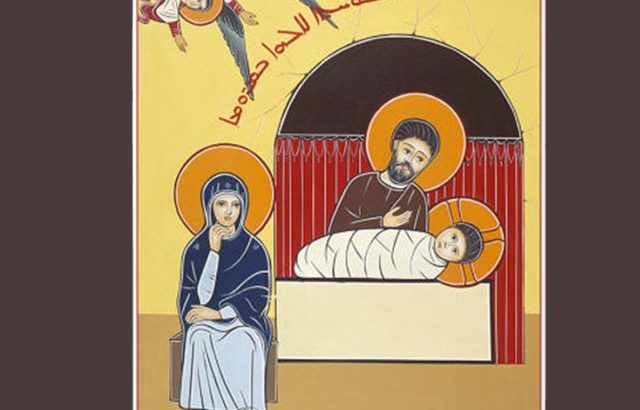
 Christmas Icon was produced after the manner of the Rabboula manuscripts. Fr Badwi writes: “The Blessed Virgin is seated with her hand on her chin, thinking and meditating on this great event, the miraculous birth which initiates the history of salvation. She is modelled on the Muse of History in Greek mythology. Near her lies the wrapped child, in the form of an altar and tomb. He is born to be sacrificed and to die for us. Joseph the Just is respectfully inclining behind the manger. The grotto and the veil stand for the grotto in Bethlehem, despite their unrealistic form. Angels trans-pierce the celestial circle, singing “Glory to God in the Highest,” written her in Syriac.”

In Liturgical Year Iconography, he reproduces some ancient illustrations he used in preparing this icon. Fr Badwi has very carefully managed to include all the important details, in so neat and orderly a form that we do not notice how much has been packed in. Compare this icon to the other Nativity Icons that come up on a web search, and you will see how uncluttered and clean it is.

First, centre stage is held by the Christ Child in swaddling bands. Today infants are wrapped in bunny rugs, but in the old days they were “swaddled,” or kept tight and warm by using strips of material. It was known in those days that the best way to keep warm is not have thicker coverings, but to use more coverings, because these trap the air between them, and that warm air is the best protection of all. Notice how the Christ Child lies on the cradle: it is presented as if it were an altar, and he the Holy Offering upon it.

An altar is integrally related to a tomb, because it is a place of sacrifice; where life on one level is exchanged for life on a higher. But because it is that type of tomb, the altar is a tomb which points both to resurrection and to death. The altar is a tomb where death is not just reversed into life, but is raised into a higher life.

The next figure after the Lord, is surely St Joseph, who is bending towards his foster son in a simple and dignified gesture of piety. He is both gesturing to the child and also to his own breast, as if he is saying: “This child is in my heart.” The Lord’s eyes are looking directly at us, but St Joseph’s and Our Lady’s eyes are gazing across our right hand side of the icon. The angels are looking down, diagonally, and across, but not at us. We are engaged, in this icon, by the Christ Child and by Him alone. He is absolutely the centre, and His halo is already marked with the sign of the Cross, while those of the other holy figures are plain.

Note that behind the Lord and His foster father, there are cracks coming from the top of the arch. Remember that these represent the grotto in Bethlehem. The veil, which Fr Abdo refers to, is also the veil of the Temple which will be split when the Lord dies on Good Friday (Matthew 27:51; Mark 15:38; and Luke 23:54). Hence, I suggest, the cracks, because from the moment of the birth of the Lord, the old order is being prepared to pass away, having fulfilled its divine purpose, and being fated to be surpassed and superseded by the New.

When Fr Badwi writes that Our Lady was modelled on Clio, the Greek Muse of History, he must mean in the calmness of her expression. I have looked at a number of illustrations of her from ancient Greek art, and in none of them is she shown in this pose. Usually, she is shown with a trumpet, or with her right hand raised, and a finger pointing upwards, for she is known as “the Proclaimer,” since history makes great events known. Yet, Clio herself is not shown as excited or emotional. The one who reads history must read carefully and attentively, not being swept away by their feelings. This does fit in with the image of Our Lady as being the one who pondered all these things in her heart (Luke 2:19 and 51, although to be fair to St Joseph, St Matthew tells us that he too pondered what he had seen: Matthew 1:20).

And this brings us to the very greatest difference between this depiction of the Nativity and any known to me from the Western tradition. There are very few, practically no, representations of St Joseph tending to the child at the crib, while his mother is sitting before him. There are of course many depictions of St Joseph holding or nursing the infant, but almost never with Our Lady present, but watching rather than participating in the scene.

Yet, this feature is shown in the ancient example from the Rabboula manuscript which Fr Badwi gives as an example of the illustrations  he used in preparing his icon. So, even in the Syriac tradition, there was a tradition of depicting St Joseph tending for the Infant Jesus as he lay in his swaddling bands, as Mary sits apart meditating. Why?

I suggest that here Our Lady is the middle, between the angels who appear from out of heaven on high and her husband. She does not know all that the angels know, but she does realise that she is present before a very great mystery, and so she seeks understanding. Our Lady’s posture is a reminder not to allow ourselves to become lost, even in the adoration of the Lord. We are not made to lose ourselves in worship, but to find ourselves in contemplation of the divine.

Finally, one another strange feature is found both in this icon and in the Rabboula original, but never in Western art: the Infant Jesus is depicted at approximately two thirds the size of the adults. He is still a child, but he is more. I think the reason is that he is already complete in his divinity, although as a human he still has to grow. There was a feature in ancient art where the most important figures (e.g. a king) were always depicted as larger than the others. This depiction of the child as extraordinary in size is done with the same feeling: but he is not shown as larger than the adults, only as preternaturally big for a baby.

So there are two rather unusual aspects in this aspect which only come to light when we meditate on it: the reversed positions of St Joseph and Our Lady from what we would expect, and the disproportionately large depiction of the Lord. These things have a feeling impact on us, even if we cannot always explain why. They make an impression.

11.24.2020

The Announcement to Mary


 The Announcement to Mary is the second week of the Maronite Season of the Nativity or the Announcement. When we discussed the Announcement to Zechariah we said something about the calendar and its seasons. Let us go deeper into the annual seasons: the cycle of feasts, fasts, and celebrations presents to us a complete course of the life of the Lord, of salvation history, and of our situation between time and eternity.

If we prayerfully follow the calendar, our minds and hearts are gently turned, week by week, to witness another aspect of God’s action in history; we deepen our knowledge of the Lord, His blessed mother, and His saints; we ponder the mystery of death on the Sundays of the Deceased, and we join in the sadness of the Passion and the joy of the Resurrection.

If we prayerfully follow the calendar, we will always have food to nourish us: food which is familiar but also varied. We have our regular devotions, but not those and nothing else. Just as physically we need a balanced diet, so too, in the spiritual life, we need a balanced diet of prayer. Sorrow in its right time, joy in its right time, teaching of virtue and warning against evil; expectation and fulfilment. The feasts of the calendar deliver all these to us. They present the whole of the faith in a sane and accurate way: the emphasis on God the Holy Trinity, but not forgetting the angels and saints; and we remember saints of many different descriptions: martyrs, scholars, men and women of action, clergy and laity.

The liturgical calendar gives us a direction through the year, and it provides us with balanced spiritual nourishment.

The Announcement to Mary

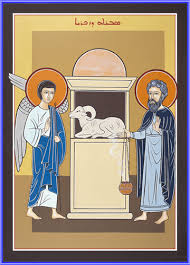
Once more, let us begin by contemplating the icon painted by Fr Abdo Badwi. It is closely based on five ancient icons. They are all strikingly similar, and yet they are all distinctive.

Fr Badwi wrote of this icon: “The Announcement to Mary is one of the oldest themes in Christian iconography. This icon is from the same inspiration as the previous one (the Announcement to Zechariah). The Virgin is standing in front of the veil of the Temple, symbol of her virginity because she is the Temple in which the Lord was pleased to dwell, whilst maintaining her virginity. She is pulling out a string (thread) from the basket (at her feet). According to the tradition, she is weaving the veil of the Temple with the chosen virgins. Her hand gesture is a sign of reception and submission. There is a spring and a water jar near her. She preserves the water of life and gives it to us. Another Syriac tradition places the Announcement near a well. The Archangel carries a pilgrims’ rod in his left hand, and greets her with his right hand. The Holy Spirit, in the form of a dove, is a later tradition in iconography.”

At the top of the icon is written sbartō d.yōl.dat a.lō.hō, meaning “The Tidings of the Mother of God.” As with Zechariah, s.bar.tō or “good tidings” links this feast to the Gospel of the Lord Jesus Christ.

The Holy Spirit enters from the top left hand, just as the angel is shown on every single one of the five ancient icons, and this one, entering from the left. The divine therefore encounters us from other dimensions. The Holy Spirit enters from the upper left, while St Gabriel the Archangel, enters from the middle level. Note, his right foot is raised, and his left foot, which goes before him, is flat. So he has arrived from the left, but he is standing higher than the level of the jar which is catching water from the well. So, although Gabriel is addressing Our Lady from eye level, he is in fact walking on the air, and she is standing on a platform. That is, although the divine messenger comes to us, and speaks to us on our level, yet he in himself belongs to the higher world.

Our Lady stands beneath the cupola of the Temple, and behind her is the veil of the Temple. As Fr Badwi said, she is weaving that veil. There is a very ancient Christian legend, known as The Protevangelium of James, although its true name may have been The Genesis of Mary. It is the oldest surviving sustained Christian study of Our Lady. By telling her story, it provides more reverent and uplifting teaching about her than three volumes of theology ever could. It is the oldest source to tell us that her parents’ names were Joachim (Yuwakim) and Anna (Hanna).

It also tells us that Our Lady was living in the temple complex, and worked at the weaving of the veil of the Temple – the veil which separated the holiest part of the Temple, protecting it from the entry of the impure and unholy. That was the very veil which was rent in half at the death of the Lord on Good Friday. This gives evidence of the very deep thought and spiritual understanding which went into this story, because it connects her action of knitting with her conception of the Lord and His formation in the womb; and it connects the end of her handiwork (the veil) to the death of the Lord. It also connects the Lord to the Temple. In other words, possibly as early as the second century A.D., Christians had been given the grace to understand that Mary’s work was at the end of the Old Covenant and the birth of the New, that by her acceptance, the Temple (the world) was brought to its greatest perfection, and it was embodied in the Lord who died, but by dying, made life eternal. They understood that where the divine and the earthly meet, there is a curtain: the curtain hides, and it reveals: one cannot see past it, but seeing it, one knows that something is hidden. And so the search is over when we reach the final veil, because behind that veil is God.

In terms of Syriac typology, what the Genesis of Mary is teaching, although as a tale rather than as a catechism, is that Our Lord is the true Temple, and because the Temple is the Universe, He is the essence of all the Creation. This also means that when we read the Bible, we can read Our Lord as the Temple, and as all the creation. There is a wide Creation and Temple-theology related to this, but I wish to pass on to just one more feature: the well and the replete jar.

Why, in five out of our six icons, does the iconographer draw the well as if it were a sort of tunnel of blue emerging from a box? That is not how wells look: they are openings in the earth, and in the ancient Near East, they were often circular brick structures with a rope going over the side so that buckets can be lowered in. So why this strange way of drawing the water?

I think that the answer is found in ancient Egyptian art. Although the Egyptians usually depicted water by drawing wavy lines, when they drew pools and wells, they were often depicted similar to what we see in this icon. They usually painted objects by showing them not as we see them when looking at them, but as we do when thinking about them: e.g. showing the entire eye, and not just the little part we see. So here we see the surface of the water, even though it is shown unrealistically above the level of the jar, as if it dripping water into the jar, when in fact the jar would have to be lowered into it. In Reading Egyptian Art, Richard H. Wilkinson explains that water was, for them, “the primeval matter from … all things arose; and the pool could thus signify the primeval waters of the First Time” (137). I think this gives us another clue to the reason water is shown here: according to typology, the waters of the earth are the waters of the creation – and the Lord is about to be incarnated, created in human form. In the presence of Mary, the jug is being filled: the creation is flowing from the source into this world in a special form.

Just as the wool took form as the veil of the Temple, so the water takes form when it flows into the jar. So too, the Lord takes form in the womb of the believing maiden. This icon, then, is an icon of the mystery of creation: through the Holy Spirit, through water, and by the faith of the Virgin.


11.13.2020

Joyful Anticipation - the Season of Announcements


The Maronite Season of the Nativity or the Announcement, meaning the Announcement of the Birth of the Messiah, is a season of the miraculous. It is full of miracles, and we insist that the miracles of the season are to be understood literally, and not only as symbols. In the events we remember at this time, we see heaven putting forth its power and working wonders on the earth.

I would go so far as to say that if we do not acknowledge and celebrate the supernatural origin of Christianity, we cannot understand Christianity – rather, we remake it as a sort of human philosophy and ideology with some fetching stories attached. The feasts we celebrate on each Sunday in the Season are also observed on each day of the week which follows them. They are the spine of the season, the destinations of the Christmas journey. There are nine such feasts, two of which, Christmas and the Circumcision can fall on any day of the week, not necessarily Sunday.

  1. The Announcement to Zechariah (Luke 1:5-21 and 57-79)
  2. The Announcement to Mary (Luke 1:26-38)
  3. The Visitation of the Virgin to Elizabeth (Luke 1:39-56)
  4. The Birth of John the Baptist (Luke 1:57-66)
  5. The Revelation to St Joseph (Matthew 1:18-25)
  6. Genealogy Sunday (the Sunday before Christmas) (Matthew 1:1-17)
  7. Christmas, or the Birth of the Lord (Luke 2:1-20)
  8. Sunday of the Presentation of the Lord in the Temple (the first Sunday after Christmas) (Luke 2:22-38)
  9. The Circumcision of Our Lord, New Year’s Day (for some years now, World Peace Day) (Luke 2:21)

The proper attitude for this Season is one of joyful anticipation, and then delight and gladness at the birth of the Lord. It is a time to recover within ourselves the purity and innocence of the infant we were once were. We cannot live that innocence all the rest of our lives, after all, we are no longer children and must put away childish things (1 Corinthians 13:11). But that is not all – we can still have the influence of that cleanness, and indeed we should, for Our Lord Himself told us that we must become like little children (Matthew 18:13, where Our Lord said in a literally translation: “Amen, I say to you, if you do not change and become like little children, you shall not enter into the Kingdom of the Heavens.”)

My conclusion from this is that the Season of the Nativity is the ideal time to take this teaching of the Lord seriously, by joining with all our mind and spirit into the birth of the Lord, and His purity, goodness, simplicity, and innocence. It is a time to put away sins and the sinning heart, and to change our mind from one which approves of, or contemplates with equanimity those ways of the world which are corrupt and contrary to His will and commandments.

Read more here.

1.04.2019

Our Dignity -- The Word Became Flesh


In the beginning before God began to create, before there was anything, the Word was….the Word was with God. The Word was turned toward God. The Father and the Son were embraced in love, long before anything was created. From all eternity they were Father, Son and Spirit.

In the beginning was this Word, this Logos, and through Him, through this Word of God, all things were made. There is nothing, nothing at all, that was made apart from Him. 

Through Him God created everything in heaven and on earth, things seen and unseen, spiritual and material. God created the whole universe through Him and for Him (Col 1:16). All beings in the heavens and on the earth and under the earth will fall on their knees and proclaim that He, the Logos is Lord (Phil 2: 10 – 11).

And whoever come to Him finds life, finds light. This eternal Word of God who always has been and always will be, came into the world to enlighten the minds of everyone who seek Him in order to lead them to the Truth.

This Word, by whom everything was made came into our world as a light, as a light penetrating into the darkness, and the darkness was not able to grasp it or snuff it out.

Even though the soldiers of Herod were searching for Him, not to worship the child but to kill Him, they were not able to do so. When the hour arrived years later for His passion and death, Satan tried to extinguish His light, but the darkness of death itself could not hold Him.

 He came into this world that was made by Him, yet the world did not recognize Him. The Word of God who was present to every mind from the beginning of creation was not recognized. He came to His own people, but they did not accept Him, but to those who did receive Him, he gave them power to be called children of God, sons and daughters of God. 

As we celebrate the birth of this child, we recognize the power of life to change others. Whatever anxieties and concerns may come, they seem for the moment to find another place. Mary and Jospeh knocked on the doors of several inns, but all the lodgings were filled. The heart and the door of the stable were open. Though there was no room up-front in the inn, there was this secret little place in the back. Wouldn’t it be wonderful if we could keep this spirit of Christmas alive throughout the year, throughout the day for just 5 minutes?

So often our lives become so filled with business, busyness at home, at work, wherever. If only Christmas peace could last forever.

Have you ever seen a baby bound up hands and feet swaddled? That’s not the baby we see in our mangers today. The baby we see is only diapered, virtually naked, because this child is the new Adam who has come to restore the grace of paradise.

This child whom we honor did not come with a ready wrapped gift of peace. He had to pay a price for that peace. The baby we see in the manger lies on wood with His hands outstretched seeking to embrace all who will come to Him.

I read this story in the paper, I wish I could say that it was mine:

As I walked down the street, I noticed a dirty, filthy guy holding a cup of coffee, screaming and yelling at someone who was not there, except in his mind. But when he spotted me, he said calmly: “Mister, do you want some of my coffee?” Cringing, I knew I would have to acknowledge the poor man’s generosity. So I took a sip, and then supposed that he wanted something from me, like a $10 bill. But he put his arms up and said: “No money! A hug. Give me a hug.” Oh I wished at the moment that he would have taken the $10. The hug was a very long-lasting bear hug! I then asked him why he had offered me a cup of coffee. He replied: “The coffee this morning is exceptionally good and when God gives you something good, you have to share it”. I could hear the voice of Jesus telling me: “feed the hungry, heal the sick, take care of the homeless, this man who has just given you an embrace of love in a bear-hug”. I then realized that we should not look at the poor with pity, but to have this eerie sensation that Jesus is looking back at me with His mercy! That’s a hug!

But not all who come will embrace Him. For the gift which He offers requires the experience of pain – and of suffering, rejection, even hatred. Years later He will again be on the wood with His arms outstretched and nailed and mocked and ridiculed until He dies. This is why the Word Became Flesh – to embrace our humanity, even death.

When we are able to see with the eyes of faith, a new dignity surrounds our home, our work, our neighborhood, and our world. Isn’t our world desperately searching for the dignity that was lost in the original garden, the dignity that this child is born to bring.

A homily by Fr. Herbert Nicholls at the Mother of Light Convent on Monday, December 31, 2018.

12.25.2015

Happy Feast of the Glorious Birth

(Hoosoyo – Morning Prayer (Safro) taken from the Divine Praises on the Feast of the Glorious Birth of Our Lord)
The Sisters are remembering you in prayer at the manger.

Son of God,
Word and image of the Father,
His only begotten and well-beloved Son,
you are the infant that neither mind can encompass,
nor the spirit comprehend, wisdom fathom, science know,
nor knowledge reveal.
No description can portray you, O Lord,
no name name you, no language explain you, no lips pronounce you.

You are higher than the heavens, firmer than the earth and deeper than the abyss.
Your light is more splendid than the light,
Your sun is more brilliant than the sun,
and your day more magnificent than the day.
You are the message and messenger,
the good news and the one who brought it,
the prophecy and he who prophesied.
Jacob described you as a lion cub;
Job called you Savior and Isaiah said of you:
“a child is born to us, a son is given to us, upon his shoulders dominion rests.
They call Him: Wonder-Counsellor, mighty God, eternal Father, Prince of Peace.”
Jeremiah compared you to a ray of light,
Micah to the light, and Daniel to a precious jewel.
You were enveloped by clouds of light, descended into a cave where no light entered, and were wrapped in swaddling clothes.
You whom the throne of the cherubim is not able to contain.
Today with the angels, we surround your crib and sing:
“Glory to God in the highest and peace on earth and good will to men”.
With the Magi we offer you presents and with the shepherds give you gifts.
Lord God, Son of the Father and first born of the Virgin,
we ask you to receive our prayers.
Grant us by your birth the joy and gladness of your vision,
make us children of justice and spiritual holiness adorned with divine virtues.
Freed from the womb of the earth on the day of the resurrection, we will be new born infants, children and heirs.
Then we will enter your kingdom and give you glory and praise,
Forever.
Amen