
Showing posts with label Icon. Show all posts
Showing posts with label Icon. Show all posts
6.05.2020

4.03.2015
Explanation of Great Friday of the Crucifixion
The Church
today celebrates the great and wondrous mystery of Christ’s death upon the
cross. Jesus Christ is our new passover who gives us his body and blood as our
spiritual food and drink. He replaces the bread and wine of the paschal meal
with his very body and blood.
The paschal
lamb of the old covenant he abolishes, and in its place he offers himself as
both priest and victim and thus inaugurates the new covenant in his own blood.
As John the
Baptist proclaims, he is truly “the Lamb of God who takes away the sins of the
world.” And as St. Paul says, “Christ our passover has been sacrificed for us;
therefore let us keep the feast.”
The Divine
Mysteries are not celebrated today, instead the pre-sanctified liturgy of the
Anaphora of the Signing of the Chalice is used. The prayers of this anaphora
are among the most ancient of the Syriac Church. Holy Communion is distributed
during the pre-sanctified liturgy from the Mysteries consecrated yesterday.
In addition
to the celebration of the pre-sanctified liturgy the Church also recalls the
mystery of the cross by the rite of adoration of the cross and the burial of
the Lord.
The cross is
the sign of the Lord’s sacrifice and death, and yet it is also the beacon of
light and symbol of hope and victory.
The whole
earth has been enlightened by the light of the cross, and the darkness of
ignorance has been turned back.
As we adore
the cross and recall the burial of the Lord we call out: O Lord, we worship
your cross, for it is our resurrection and renewal.
O Christ
crucified for us, have mercy on us.
HYMN
For us the
Son of Man suffered and died hanging on a cross.
He sent his
spirit to God, the Master of the universe.
The rocks
split and the tombs opened;
the entire
world was afflicted.
The heart
poured water and blood for the life of mankind.
Cross of the
Savior,
teach me of
your power.
Help me to
understand why everyone prostrates
before your
majesty.
I became the
altar at the summit of Golgotha.
On me the
Son of almighty God was crucified.
From him
flowed water and blood for the forgiveness of mankind.
The Church
sings the glory of the cross for ever.
Taken from the Maronite Divine Office (Ramsho) for
Great Friday of the Crucifixion

Maronite Icon: The Crucifixion
The Lord on the cross is dressed with the royal tunic, raising his head like a cub who sleeps with open eyes. His cross is erected on Adam's skull. His Mother looks at him and the Beloved One bows his head. The eclipsed sun and moon symbolize the cosmic presence in this parousia scene. This iconographical type was dominant to the ninth century.
The Lord on the cross is dressed with the royal tunic, raising his head like a cub who sleeps with open eyes. His cross is erected on Adam's skull. His Mother looks at him and the Beloved One bows his head. The eclipsed sun and moon symbolize the cosmic presence in this parousia scene. This iconographical type was dominant to the ninth century.
5.15.2009
Our Lady of the Maronites
By Sister Marla Marie 
The icon pictured here is of Our Lady of Ilige (ileej), also known as Our Lady of the Maronites and the Patriarchcal icon. In more recent times, our Maronite Churches have displayed replicas of this icon in their sanctuaries. Why? Where did it come from? On my recent trip to Lebanon, I went on a pilgrimage to pray at the original site of this treasured icon and while there, discovered its interesting history.
The Church of Our Lady of Ilige is located in the village of Mayfouq in the district of Jbeil. It was built at the site of a former pagan temple, and parts of that structure are still visible in the Church building.
The word Ilige is derived from the name of the temple which was to honor the god of depth. It is claimed that Christians made the site a Church back in Apostolic times, dedicating it to the Mother of God as Our Lady of Ilige. From the the 12th to the mid- 15th century this Church was the refuge, shelter and home of our Maronite Patriarchs.
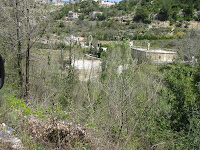
I arrived at the Church of Our Lady of Ilige on Holy Saturday, anticipating with great excitement my visit to this former residence of the Patriarchs and the sanctuary of the icon. As you can see from these photos, the church is quite small, old, and a typical stone structure of the mountain villages.


The icon pictured here is of Our Lady of Ilige (ileej), also known as Our Lady of the Maronites and the Patriarchcal icon. In more recent times, our Maronite Churches have displayed replicas of this icon in their sanctuaries. Why? Where did it come from? On my recent trip to Lebanon, I went on a pilgrimage to pray at the original site of this treasured icon and while there, discovered its interesting history.
The Church of Our Lady of Ilige is located in the village of Mayfouq in the district of Jbeil. It was built at the site of a former pagan temple, and parts of that structure are still visible in the Church building.
The word Ilige is derived from the name of the temple which was to honor the god of depth. It is claimed that Christians made the site a Church back in Apostolic times, dedicating it to the Mother of God as Our Lady of Ilige. From the the 12th to the mid- 15th century this Church was the refuge, shelter and home of our Maronite Patriarchs.
I arrived at the Church of Our Lady of Ilige on Holy Saturday, anticipating with great excitement my visit to this former residence of the Patriarchs and the sanctuary of the icon. As you can see from these photos, the church is quite small, old, and a typical stone structure of the mountain villages.


The second floor housed the residence of the patriarchs, comprised of a couple of small rooms which tell of the simplicity and austerity of their life.


As I stood facing the altar, I noticed a large painting of the Mother of God, but it was in the style of late 18thcentury Italian art with hints of Syriac Maronite symbols. There was no resemblance to the icon I was looking for.


The original icon of Our Lady of Ilige was actually buried under ten layers of paint in subsequent attempts to fix, improve, or adjust the icon over the centuries. As a result, the icon was covered over, only to be discovered in the restoration undertaken in the 1980’s. To the surprise of the Carmelite nuns assigned to the restoration, layer after layer was uncovered to reveal the original, an icon of Syriac Maronite art dating to the 10th century.
This explains why this icon has only recently appeared in our Maronite Churches. It is new to us, but one of our oldest preserved icons which belonged to the Patriarchs. Let us treasure it.
By the way, the picture I saw in the Church of Our Lady of Ilige was a reproduction of what the painting looked like before restoration. I later found out that the original icon is securely displayed at a nearby Monastery.
We do not have many pieces of our art from the early centuries due to wars, persecutions and the destruction of Churches over time. The discovery of this icon is a blessing and gift to the Maronites, as it preserves the unique style of Syriac Maronite art form.
An explanation of the significance of symbols and colors of this icon can be found on the NAM website.


The original icon of Our Lady of Ilige was actually buried under ten layers of paint in subsequent attempts to fix, improve, or adjust the icon over the centuries. As a result, the icon was covered over, only to be discovered in the restoration undertaken in the 1980’s. To the surprise of the Carmelite nuns assigned to the restoration, layer after layer was uncovered to reveal the original, an icon of Syriac Maronite art dating to the 10th century.
This explains why this icon has only recently appeared in our Maronite Churches. It is new to us, but one of our oldest preserved icons which belonged to the Patriarchs. Let us treasure it.
By the way, the picture I saw in the Church of Our Lady of Ilige was a reproduction of what the painting looked like before restoration. I later found out that the original icon is securely displayed at a nearby Monastery.
We do not have many pieces of our art from the early centuries due to wars, persecutions and the destruction of Churches over time. The discovery of this icon is a blessing and gift to the Maronites, as it preserves the unique style of Syriac Maronite art form.
An explanation of the significance of symbols and colors of this icon can be found on the NAM website.
6.21.2008
Mother of the Light

This icon depicts Mary presenting the Christ Child to the viewer. The dome at the top consists of a blue arch, a middle row of leaves, and a sheet of gold with inlaid gems, and symbolizes the life of the Triune God. The shrine, represents the Kingdom in which dwell Mary and the Lord of heaven and earth. The Lady of paradise is dressed in a purple cloak, a color reserved for kings and queens, which suggests that she is the Mother of the King. Her red shoes, the footwear of Byzantine queens, notes that Mary is the mother of the Divine Lord. The Child holds a scroll of the eternal law for Christ is its fulfillment.
Subscribe to:
Posts (Atom)